Payday super from 1 July 2026, and the subcontractor rule
Super is due within seven business days of every payday. Section 12(3) makes anyone working under a contract wholly or principally for their labour your employee for super, ABN or not.
Zirko RedaktionPublished: Updated: 9 min read
Contents
Two rules about superannuation matter to a building business, and only one of them is new.
The new one changed the timing: super is now tied to each payday rather than to a quarter. The old one decides who you owe it to, and it has caught out builders continuously since 1992.
The new rule: the QE day and the seven business days
The Superannuation Guarantee (Administration) Act 1992, as compiled on 1 July 2026, is built around a new pivot. Section 17A(1):
"This Subdivision applies if an employer makes a payment of qualifying earnings to or for an employee on a particular day (the QE day)."
Section 17 gives the outline in plain terms:
"If on a particular day an employer: (a) pays qualifying earnings to an employee; or (b) reduces an employee's qualifying earnings so that a sacrificed contribution can be made for the employee; then, on that day, the employer has an individual superannuation guarantee amount for the employee equal to a particular percentage of the payment or reduction."
That percentage is fixed in s 17A: "charge percentage means 12."
The window
Two defined periods carry the whole timing reform.
"usual period, for a QE day and an employer, means the period: (a) starting on the QE day; and (b) ending on the seventh business day after the QE day."
"extended usual period, for a QE day and an employer, means the period: (a) starting on the QE day; and (b) ending on the 20th business day after the QE day."
Section 18C(1) then makes those periods the test. An employer's individual base superannuation guarantee shortfall for an employee and a QE day is calculated by reference to "eligible contributions relevant for the QE day", which are contributions
"received during one of these periods (the standard periods): (i) the usual period for the current QE day; or (ii) the 12-month period ending on the day before the current QE day …"
The word to notice is received. Not sent, not authorised, not debited from your account. If the contribution reaches the fund on the eighth business day, it did not fall inside the usual period.
Anyone who has watched a clearing house sit on a batch over a weekend will see the problem immediately: with a quarterly deadline, two or three days of settlement lag was invisible. Against a seven-business-day window it is a third of the window.
The twenty-business-day case
The table in s 18C(2) lists "allowable longer periods for receiving eligible contributions". Item 1 covers the first contribution to a particular fund:
"the eligible contribution is the first eligible contribution made to a particular complying superannuation fund or RSA by the employer for the benefit of the employee: (a) after the employee commenced (or recommenced) employment with the employer; or (b) after the employer ceased making one or more eligible contributions for the benefit of the employee to another complying superannuation fund or RSA"
— in which case the contribution may be received "during the extended usual period for the current QE day."
This is the new-starter allowance. It applies to the first contribution to that fund, not to the first quarter, and it does not extend to the second payday.
Qualifying earnings
Section 10A(1) defines qualifying earnings by a list of paragraphs, and paragraph (h) brings in the salary sacrifice case: reductions in a person's earnings made in return for a sacrificed contribution. Section 10A(4) then defines what a payment of qualifying earnings is:
"A payment of qualifying earnings to or for an employee by an employer means: (a) a payment of qualifying earnings to the employee by or on behalf of the employer; or (b) for qualifying earnings described by paragraph (1)(h) — the reductions described in that paragraph made in return for the making of the sacrificed contribution for the benefit of the employee."
So a salary sacrifice arrangement produces a QE day and starts a seven-business-day clock in exactly the same way as a cash payment.
Section 10A(5) preserves a maximum contributions base, expressed per payment of qualifying earnings and rounded down to the nearest multiple of $10, and s 17B allows an employer shortfall exemption certificate to reduce the amount to nil for a period that includes the QE day.
The old rule: who counts as an employee
This is the provision that costs building businesses money, and it has not changed since the Act commenced.
Section 12(1) starts by saying that "employee" and "employer" have their ordinary meaning, then that subsections (2) to (11) "expand the meaning of those terms".
Section 12(3):
"If a person works under a contract that is wholly or principally for the labour of the person, the person is an employee of the other party to the contract."
Nothing in that sentence mentions an ABN, an invoice, a business name, GST registration, or what the parties called the arrangement. The test is the substance of the contract: is what is being bought essentially this person's labour? That is a different ABN question again from the withholding duty that falls on you when a subcontractor's invoice quotes none at all — the withholding duty is the payer's.
For a construction business, three common arrangements sit close to the line:
- A labour-only subcontractor who supplies no material and no significant plant, works to your direction and is paid by the hour or day. That is the paradigm case of s 12(3).
- A subcontractor with an ABN who works exclusively for you, using your tools and your vehicle. The ABN is irrelevant to s 12(3); the terms are not.
- A subcontractor who supplies materials and plant and quotes a price for a result. That is further from s 12(3), because the contract is for an outcome rather than for the person's labour.
Section 12(2) also catches company directors: a person entitled to payment for performing duties as a member of the executive body of a body corporate "is, in relation to those duties, an employee of the body corporate." Working directors who pay themselves directors' fees are inside the guarantee.
Getting this wrong is not a timing problem. If s 12(3) applies and no contributions were made, the shortfall is not late — it never existed, and it accrues per QE day from the day the arrangement started.
What the two rules together mean for a builder
The reform makes an existing exposure move faster. Under a quarterly system, a misclassified subcontractor produced one shortfall per quarter. Under the payday system, a shortfall arises per QE day — which, for a weekly-paid crew, is fifty-two of them a year.
Three things follow.
1. Pay super in the same run as wages. The only reliable way to land inside a seven-business-day receipt window is to initiate the contribution when you initiate the pay, not at the end of the month. If your clearing house has a settlement lag, subtract it from seven when you set the internal deadline.
2. Treat the fund's receipt as the milestone. Section 18C(1) is about receipt. Keep the confirmation from the clearing house or fund with the pay run, not just the bank transfer.
3. Review labour-only arrangements against s 12(3) once, deliberately. Not "do they have an ABN", which the section does not ask, but "is this contract wholly or principally for this person's labour". If the answer is yes, they are an employee for super, and the payday clock applies to them too.
The record-keeping consequence is dull and decisive: you need to know, per person and per day, what work was done and what was paid for it. That is the same information that tells you what a job cost, and it is also what a Taxable payments annual report needs each August — the 50 per cent test and 28 August. Businesses that keep it for one purpose usually find they have already kept it for the other.
---
Checked on 29 August 2026 against compilation 78 of the Superannuation Guarantee (Administration) Act 1992, compilation date 1 July 2026, on the Federal Register of Legislation. This describes the legislation and is not tax or employment advice; whether a particular contract is wholly or principally for a person's labour is a question of fact that the ATO and the courts decide on the terms and the conduct of the parties. Take the maximum contributions base figure and any current administrative concessions from the ATO rather than from an article.
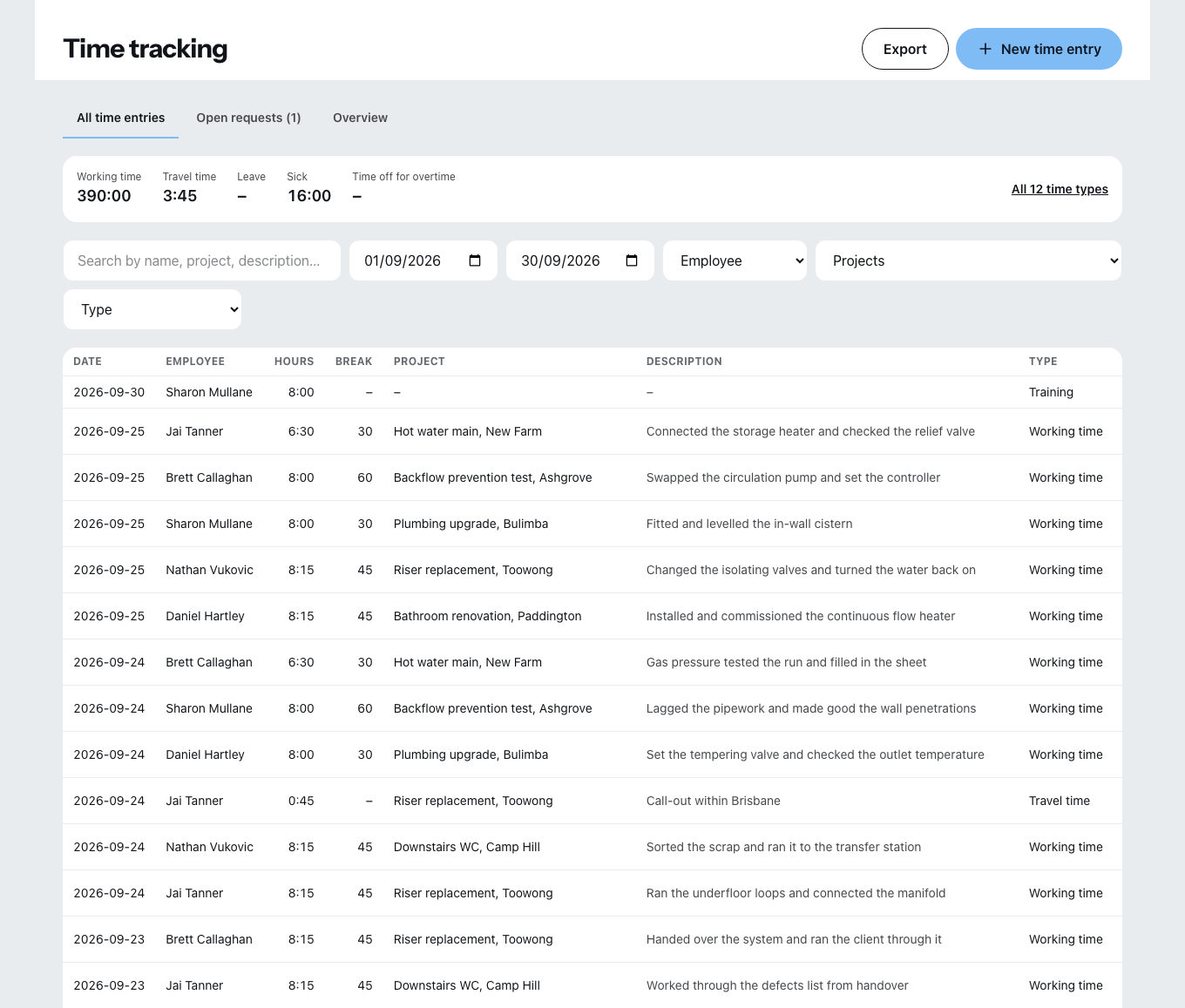
What Zirko does: it records time per employee per day against the project it belongs to, which is the underlying record behind both a pay run and a job cost. What Zirko does not do: it is not payroll software. It does not calculate superannuation guarantee, does not send contributions to a fund, and does not decide whether someone is an employee.
Frequently asked questions
What changed on 1 July 2026?
The timing. The Superannuation Guarantee (Administration) Act 1992 as compiled on 1 July 2026 works from a QE day — the day an employer makes a payment of qualifying earnings to or for an employee — and the usual period for a QE day runs from that day to the seventh business day after it. Contributions received by the fund inside that window count; those that arrive later create a shortfall.
Is it seven days from payday or seven days to the fund?
To the fund. Section 18C(1) counts only eligible contributions received by the relevant fund, RSA, representative or scheme during the usual period. Sending the money on the seventh business day does not help if the fund receives it on the ninth.
Is there any longer period?
Yes, for the first contribution to a new fund. The extended usual period runs from the QE day to the 20th business day after it, and the table in s 18C(2) applies it to the first eligible contribution made to a particular complying superannuation fund or RSA after the employee commenced or recommenced employment, or after the employer stopped contributing to another fund for that employee.
What rate applies?
Twelve per cent. The formula in s 17A(2) uses a charge percentage, and s 17A defines charge percentage as 12. It is applied to the amount of the qualifying earnings paid on the QE day.
Do I owe super to a subcontractor with an ABN?
Possibly. Section 12(3) has been in the Act since 1992 and is unchanged: if a person works under a contract that is wholly or principally for the labour of the person, the person is an employee of the other party to the contract. Holding an ABN, invoicing, or being called a subcontractor does not answer the question — the terms of the arrangement do.
Does salary sacrifice count towards my obligation?
It is inside qualifying earnings rather than a substitute for the obligation. Section 10A(1)(h) brings into qualifying earnings the reductions made in return for a sacrificed contribution, and s 10A(4)(b) treats those reductions as a payment of qualifying earnings — so they create a QE day of their own.
Continue reading
- The certificate clock that starts after testing: NSW, Victoria
In New South Wales a CCEW is due seven days after the safety and compliance test. In Victoria a prescribed job cannot be energised until a licensed electrical inspector has passed it.
- Tradie invoice: the $1,000 line most jobs cross
The Friday run for an Australian trade business: was the quote GST-inclusive, the $75 and $1,000 lines, the payment claim that is not a tax invoice, and a sub who quoted no ABN.
- Job management software for tradies: the GST line in a quote
Two of the best-known job management tools in Australia quote on opposite tax bases: one includes GST, one excludes it. The same rule decides how your quote to a homeowner has to look.
- Builder licence thresholds in NSW, Victoria and Queensland
$5,000 in New South Wales, $10,000 in Victoria, $3,300 in Queensland. Cross the line without the right licence and two of three states take the money away entirely, not the profit.