Job management software for tradies: the GST line in a quote
Two of the best-known job management tools in Australia quote on opposite tax bases: one includes GST, one excludes it. The same rule decides how your quote to a homeowner has to look.
Zirko RedaktionPublished: Updated: 7 min read
Contents
Put the two best-known job management tools in Australia side by side and the headline numbers lie to you. Checked on 21 September 2026, ServiceM8's Australian pricing page carries the line "Prices are in AUD and include GST" above plans at $29, $79, $149 and $349. Tradify's Australian pricing page prices Lite, Pro and Plus at $48, $52 and $62 per user per month, each marked "Ex GST".
So the $79 plan is $71.82 before tax and the $52 plan is $57.20 after it. A tradie doing the obvious subtraction gets $27. The real gap on a one-person business is $19.82 — about a quarter less than it looks.
Neither page is hiding anything. Both state their basis in plain words. The interesting part is why two vendors in the same category, on the same day, in the same country, quote differently at all — because the answer is a rule that applies to your quotes as well as to theirs.
The single price rule, and the door it leaves open
The ACCC's guidance on displaying prices is short and it decides the question: "Businesses must display the total price of a product or service as a single figure." That figure has to be "the minimum total cost — the lowest amount a customer could pay, including any taxes, duties and unavoidable or pre-selected extra fees."
Then comes the sentence that explains the split: "If a business is displaying prices only to other businesses, it doesn't need to include GST in the total price."
That is the whole thing. A vendor selling to sole traders and householders quotes GST-inclusive because it is the safe reading. A vendor positioning itself as business-to-business quotes ex GST because it is allowed to. Neither is wrong; they have different audiences.
And so do you. A quote to a homeowner for a bathroom has to be a single total with GST in it. A quote to a head contractor for the same scope of works can lawfully be ex GST. Most tradies work both sides of that line in the same week — which means the question to ask of job management software is not "does it handle GST" but "can the same price list produce both presentations without anyone retyping a number".
Why retyping is the actual risk
A price that gets recalculated by hand once is a price that gets recalculated by hand a hundred times, and the errors do not distribute evenly: they cluster on the jobs that changed after the quote went out.
The arithmetic itself is trivial. GST is 10 percent of the value of the supply under section 9-70 of the GST Act, which means it is one eleventh of a GST-inclusive figure. The trouble is not the sum, it is the round trip — quote inclusive, cost ex, vary the scope, re-quote, invoice. Every hop is an opportunity to carry the wrong base forward, and the one that reaches the customer is the one they signed.
What has to appear on the document at the end of that chain is set out in the $75 and $1,000 lines on an Australian tax invoice — including the two thresholds most systems get wrong, the $75 below which no tax invoice is required at all and the $1,000 above which the customer's identity or ABN has to be on it. And whether any of it applies to you starts with the registration turnover threshold in s 23-15 of the GST Act: $75,000, tested forward as well as back.
The meter that is not the price
The second thing the two pricing pages disagree about is what you are actually buying.
Tradify sells seats: $48, $52 or $62 per user per month. Add an apprentice, add $48. ServiceM8 sells the business with unlimited users — but meters it by jobs: 50, 150, 500 and 1,500 per month across its four paid plans.
For a tradie the difference is not academic, because job count and revenue are barely related. A plumber doing twelve landlord jobs a week and a builder doing one kitchen a month can turn over the same money and sit three plan tiers apart. Before comparing any two price lists, count last month's jobs and count the people who would need a login. Those two numbers decide which pricing model is cheaper for you, and they decide it more strongly than the monthly figure does.
What the office actually spends its day on
Quoting is the part tradies think about when they buy software. Chasing is the part they spend the time on.
An Australian trade business carries a second set of clocks that have nothing to do with tax: the payment claim and payment schedule deadlines under the security of payment act of whichever state the work is in, and they are genuinely different in each — the shape of the problem is in eight jurisdictions, eight sets of deadlines. Those clocks only start when a claim goes out, which puts the unsent invoice draft at the top of the list of things worth being nagged about.
Two more Australian duties belong in the same system rather than in a shoebox, because both are reconstructed from records you already hold. If a subcontractor gives you an invoice with no ABN, the withholding obligation is yours, not theirs — the rate and the exceptions are in a subcontractor gave you an invoice with no ABN. And every August the building and construction industry reports what it paid its contractors; what counts and what does not is in the 50 percent test, the 28 August deadline, and what you don't report.
Neither of those is a feature anybody demonstrates. Both are a year of small entries that either exist in one place or have to be assembled from three.
Three questions worth asking any vendor
Not "does it do quoting" — they all do quoting. These three separate the tools that fit an Australian trade business from the ones that were translated into one.
Can the same price produce a GST-inclusive quote for a homeowner and an ex-GST quote for a builder, without anybody retyping a figure? If the answer involves a second price list, you now have two lists that will drift apart.
What is the meter — seats or jobs? Then check your own last month against it. The cheaper headline is frequently the dearer plan.
When a job changes after the quote is signed, what happens to the document that was already issued? A system that lets an issued invoice be edited has no audit trail, and the version the customer holds and the version you hold stop matching on the first variation.
---
Position as at 21 September 2026. Prices and page wording for ServiceM8 and Tradify were read from their Australian pricing pages on that date and vendors change them without notice — re-read the basis line before comparing, because the basis moves more quietly than the number. This is general information about Australian rules and is not tax or legal advice. The figure to watch is the $75,000 registration threshold: it is set by section 23-15 of the GST Act and by regulation, and the test is forward-looking, so a business can cross it in the month it wins a job rather than in the month it banks one.
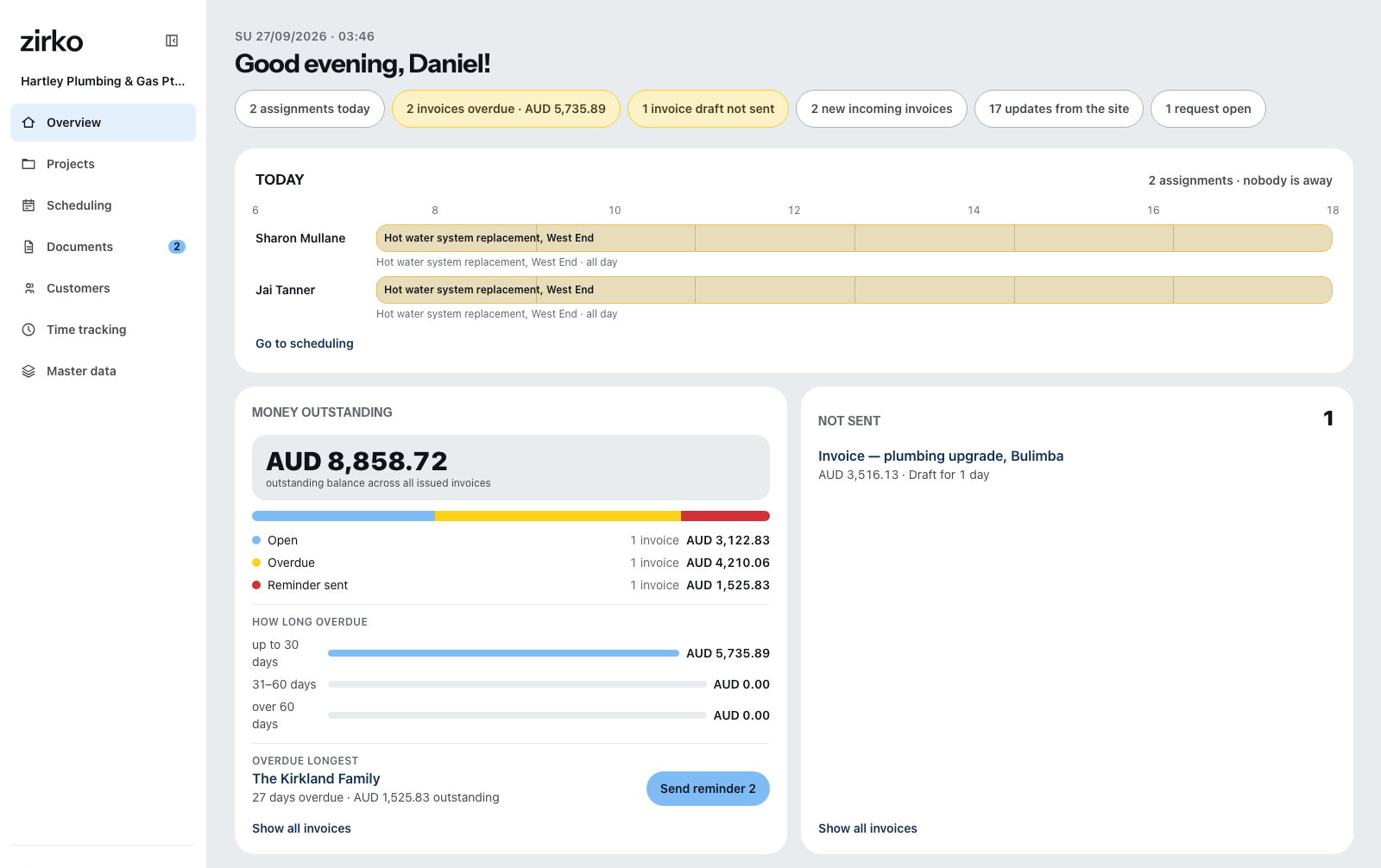
What Zirko does here: it holds one price list, applies the tax to each line of a document, and keeps quotes, hours, site photographs and invoices on the same job so that a year of small entries is in one place when a report is due. What Zirko does not do: it does not lodge a business activity statement, it does not prepare or submit a taxable payments annual report, and it does not decide whether a supply is taxable.
Frequently asked questions
Does my quote to a homeowner have to include GST?
Yes, as a single figure. The ACCC's guidance states that businesses must display the total price of a product or service as a single figure, and that this price must be the minimum total cost, the lowest amount a customer could pay, including any taxes, duties and unavoidable or pre-selected extra fees. A quote that shows a price and then adds GST underneath is the practice that rule was written about.
Can I quote a builder ex GST?
Yes. The ACCC's guidance says that if a business is displaying prices only to other businesses, it doesn't need to include GST in the total price. So the same price list can lawfully be shown two ways, and the software you use has to be able to do both without you retyping anything.
When do I have to register for GST?
At $75,000 of GST turnover in a 12-month period. Section 23-15 of the GST Act sets the registration turnover threshold, and the test looks forward as well as back — it is not last year's number and it is not the balance of the bank account.
Why do two software plans at $79 and $52 not differ by $27?
Because they are quoted on different tax bases. Checked on 21 September 2026, ServiceM8's Australian page states Prices are in AUD and include GST, so its $79 Growing plan is $71.82 before tax. Tradify's Australian page marks its plans Ex GST, so its $52 Pro plan is $57.20 with tax. The real difference on a single-user business is $19.82.
What is a job limit and why does it matter more than the monthly price?
Some plans are metered by jobs rather than by users. ServiceM8's Australian plans include 50, 150, 500 and 1,500 jobs per month at $29, $79, $149 and $349. A service business doing short callouts reaches those ceilings at a fraction of the turnover of a business doing long installs, so two tradies with identical revenue can sit three tiers apart.
Continue reading
- The certificate clock that starts after testing: NSW, Victoria
In New South Wales a CCEW is due seven days after the safety and compliance test. In Victoria a prescribed job cannot be energised until a licensed electrical inspector has passed it.
- Tradie invoice: the $1,000 line most jobs cross
The Friday run for an Australian trade business: was the quote GST-inclusive, the $75 and $1,000 lines, the payment claim that is not a tax invoice, and a sub who quoted no ABN.
- Builder licence thresholds in NSW, Victoria and Queensland
$5,000 in New South Wales, $10,000 in Victoria, $3,300 in Queensland. Cross the line without the right licence and two of three states take the money away entirely, not the profit.
- Payday super from 1 July 2026, and the subcontractor rule
Super is due within seven business days of every payday. Section 12(3) makes anyone working under a contract wholly or principally for their labour your employee for super, ABN or not.
Sources
- ACCC — Displaying prices: the single figure rule, the minimum total cost, and the business-to-business exception (checked: 21 September 2026)
- A New Tax System (Goods and Services Tax) Act 1999, s 9-70 (the amount of GST) and s 23-15 (the $75,000 registration turnover threshold) (checked: 21 September 2026)
- ServiceM8 Australian pricing page — Prices are in AUD and include GST, per-business plans with 50, 150, 500 and 1,500 jobs per month (checked: 21 September 2026)
- Tradify Australian pricing page — Lite, Pro and Plus at $48, $52 and $62 per user per month, marked Ex GST (checked: 21 September 2026)