California mechanics lien: three deadlines, two set by the owner
Serve the preliminary notice late and the lien covers only the last 20 days of work. Record within 90 days of completion, then sue within 90 days of recording.
Zirko RedaktionPublished: Updated: 10 min read
Contents
A California mechanics lien has three deadlines, not one, and losing any of them loses the security. It is one of four state calendars that share almost nothing: see mechanics lien deadlines, four states, four different calendars for how Texas, Florida and New York count instead. Preliminary notice at the start. Recording at the end. Filing suit ninety days after that. Contractors who know about the first two lose the third more often than anything else, because it arrives when the job is over and the file is closed.
Here they are with the sections, and then what each one actually does to you.
The three deadlines
| Stage | Direct contractor | Everyone else | Section |
|---|---|---|---|
| Preliminary notice | to the construction lender, if any | to owner, direct contractor and construction lender | § 8200 |
| Consequence of serving late | lien limited to work within the prior 20 days | same | § 8204 |
| Record the claim of lien | before the earlier of 90 days after completion or 60 days after a recorded notice of completion or cessation | before the earlier of 90 days after completion or 30 days after a recorded notice of completion or cessation | §§ 8412, 8414 |
| Commence an action | 90 days after recordation | 90 days after recordation | § 8460(a) |
Note where the asymmetry lives. On the outer limit both are at 90 days. But once the owner records a notice of completion, the subcontractor's window halves relative to the general's — 30 days against 60.
Stage one: the preliminary notice decides how big your lien is
Most states treat an early notice as a condition: give it or lose the lien. California made a different and more interesting choice. Section 8204 does not void a late claimant's lien — it truncates it:
"entitled to record a lien, give a stop payment notice, and assert a claim against a payment bond only for work performed within 20 days prior to the service of the preliminary notice"
Work performed before that twenty-day window is outside the security. Work performed after the notice is inside it.
Do the arithmetic on a real job. Six months of work, notice served in month five, and roughly four and a half months of your labor and material has no lien behind it. The lien technically exists. It is worth a fraction of what you are owed.
Who has to be served — section 8200:
"A claimant shall give preliminary notice to the following persons: (1) The owner or reputed owner. (2) The direct contractor or reputed direct contractor to which the claimant provides work, either directly or through one or more subcontractors. (3) The construction lender or reputed construction lender, if any."
Two exceptions in the same section: laborers are exempt from the requirement, and a claimant with a direct contractual relationship with the owner need only notify the construction lender, if there is one.
Read (2) carefully. "directly or through one or more subcontractors." A second-tier sub serves the direct contractor, not merely the sub who hired them.
The operational answer is not to get clever about the twenty days. It is to serve the preliminary notice at mobilization on every job, as a fixed step, and never think about section 8204 again.
Stage two: recording, and the owner's lever
Direct contractor — § 8412:
"A direct contractor may not enforce a lien unless the contractor records a claim of lien after the contractor completes the direct contract, and before the earlier of the following times"
— ninety days after completion of the work of improvement, or sixty days after the owner records a notice of completion or cessation.
Everyone else — § 8414:
"A claimant other than a direct contractor may not enforce a lien unless the claimant records a claim of lien within the following times"
— after the claimant ceases to provide work, and before the earlier of ninety days after completion of the work of improvement, or thirty days after the owner records a notice of completion or cessation.
Both sections were added by Stats. 2010, Ch. 697 (SB 189), operative 1 July 2012.
The thing to internalize is that the owner can shorten your clock and has no duty to tell you. A notice of completion recorded quietly in the county recorder's office on a job where you are still chasing a final payment starts a thirty-day fuse. If you are unpaid at the end of a job, checking the recorder is cheap and the alternative is not.
Also note the different triggers in the two sections. The direct contractor's window opens when the direct contract is completed. A subcontractor's opens when that claimant ceases to provide work — an earlier event, usually, and one you can date exactly.
Stage three: the ninety days that end it
Section 8460(a) is the deadline that catches experienced contractors:
"The claimant shall commence an action to enforce a lien within 90 days after recordation of the claim of lien. If the claimant does not commence an action to enforce the lien within that time, the claim of lien expires and is unenforceable."
Ninety days from recording. Not from completion, not from the last invoice, not from when negotiations broke down. And an expired lien is not merely unenforceable in court — it is a cloud on title that the owner can have removed, and you are back to an unsecured debt.
The only extension is in subsection (b), and it has to be recorded:
"Subdivision (a) does not apply if the claimant and owner agree to extend credit, and notice of the fact and terms of the extension of credit is recorded (1) within 90 days after recordation of the claim of lien or (2) more than 90 days after recordation of the claim of lien but before a purchaser or encumbrancer for value and in good faith acquires rights in the property."
Then the action must be commenced within 90 days after the credit expires, "but in no case later than one year after completion of the work of improvement."
The failure mode here is entirely predictable. You record a lien; the owner starts talking; the talking is productive; the talking takes four months. A verbal agreement to hold off is not a recorded extension of credit, and on day 91 your lien is gone.
The parallel track: getting paid without a lien
A lien is security. It is not the only remedy, and it is not the fastest.
Civil Code § 8800(a) requires the owner to pay the direct contractor within thirty days of a notice demanding payment under the contract, for any progress payment as to which there is no good faith dispute. Where there is a good faith dispute, § 8800(b) allows the owner to withhold "an amount not in excess of 150 percent of the disputed amount."
And the price of violating it — § 8800(c):
"An owner that violates this section is liable to the direct contractor for a penalty of 2 percent per month on the amount wrongfully withheld, in place of any interest otherwise due. In an action for collection of the amount wrongfully withheld, the prevailing party is entitled to costs and a reasonable attorney's fee."
Two percent per month is twenty-four percent a year, plus fees to the prevailing party. On a genuinely undisputed progress payment that is often a faster conversation than a lien — and other states set their own numbers entirely: state prompt payment laws, the same 7 days, three penalties.
Note also § 8800(d): the section "does not supersede any requirement of Article 2 (commencing with Section 8810) relating to the withholding of a retention." Retention runs on its own rules, and they differ sharply by state: retainage limits, 10 percent in Texas, 5 percent in New York.
The four dates to record on every California job
The deadlines all count from events. Most contractors cannot state the events.
- The date you first furnished work — because the preliminary notice should be served then, and because § 8204 measures backwards from service.
- The date you ceased to provide work — the § 8414 trigger for a subcontractor.
- The date of completion of the work of improvement — the outer 90-day trigger for both.
- The date any notice of completion or cessation was recorded — the trigger that shortens everything, and the one nobody sends you.
Write them down as they happen. Reconstructing them in a lawyer's office in month eight is where lien claims go to die.
---
Current as of August 29, 2026. This article describes California mechanics lien deadlines and is not legal advice. It does not cover the content and service requirements of a preliminary notice or a claim of lien, stop payment notices, payment bond claims, public works (which run under a different scheme), design professionals' liens, the effect of a notice of cessation as distinct from completion, the consequences of recording an excessive or false lien, or retention, which is governed by Civil Code § 8810 and following. The sections quoted above are taken from the official California Legislative Information site with the date they were checked. Consult a California construction attorney.
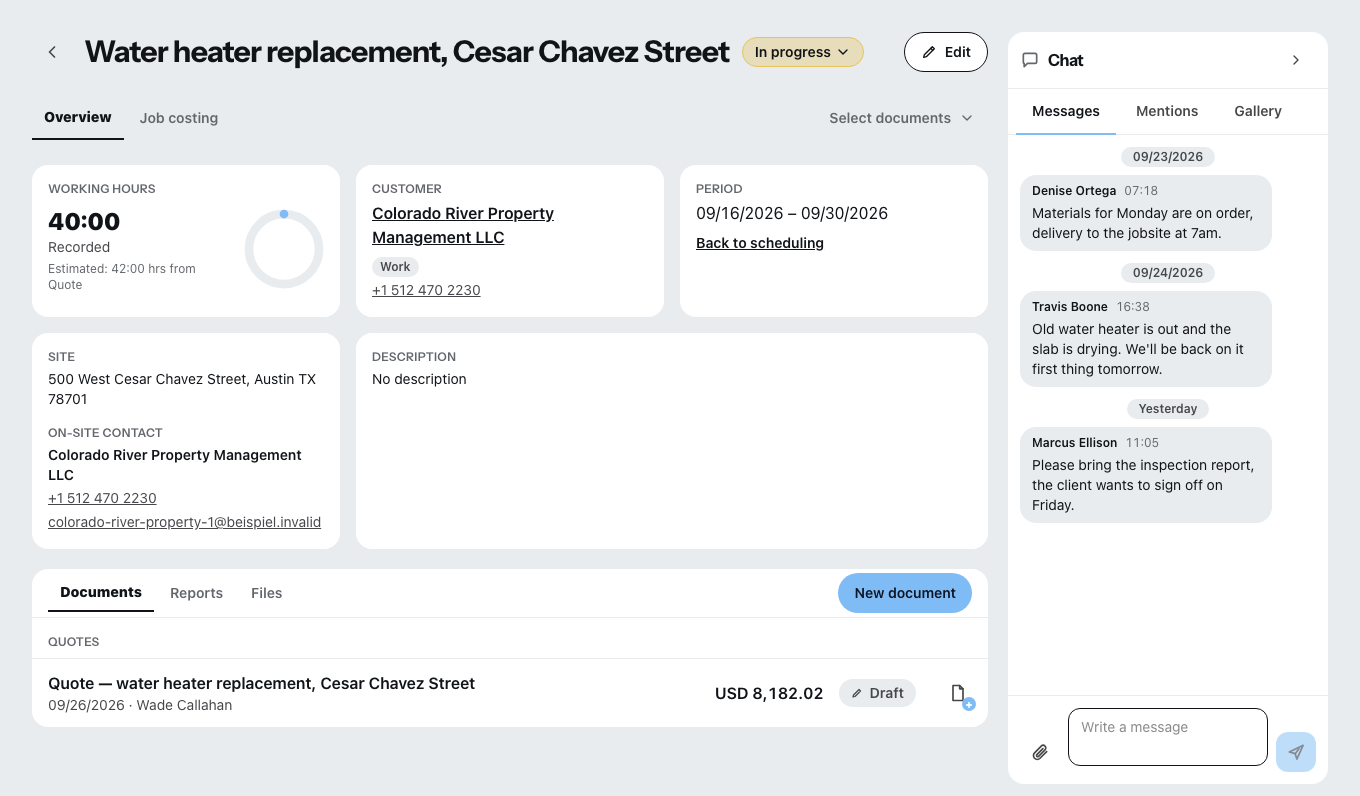
What Zirko does: it holds jobs with their dates, documents and files in one place, so the date you started, the date you last worked and the date the job completed are recorded rather than reconstructed. Zirko does not track lien deadlines, does not warn you before one expires, does not prepare, serve or record notices, and gives no legal advice. In the United States the business enters its own tax rates. Issued documents are immutable; a correction is a separate document, so the billing history of a disputed job survives intact.
Frequently asked questions
Who must receive a California preliminary notice?
Civil Code § 8200 requires a claimant to give preliminary notice to the owner or reputed owner; the direct contractor or reputed direct contractor to which the claimant provides work, either directly or through one or more subcontractors; and the construction lender or reputed construction lender, if any. Laborers are excepted, and a claimant with a direct contractual relationship with the owner need only notify the construction lender.
What happens if the preliminary notice is late?
The lien shrinks rather than disappearing. Civil Code § 8204 leaves a late claimant entitled to record a lien, give a stop payment notice and assert a claim against a payment bond only for work performed within 20 days prior to the service of the preliminary notice, plus work performed afterwards.
When must a direct contractor record the claim of lien?
Civil Code § 8412 requires recording after the contractor completes the direct contract and before the earlier of ninety days after completion of the work of improvement, or sixty days after the owner records a notice of completion or cessation.
When must a subcontractor or supplier record?
Civil Code § 8414 requires recording after the claimant ceases to provide work and before the earlier of ninety days after completion of the work of improvement, or thirty days after the owner records a notice of completion or cessation.
How long do I have to sue after recording the lien?
Ninety days. Civil Code § 8460(a) provides that the claimant shall commence an action to enforce a lien within 90 days after recordation of the claim of lien, and that if the claimant does not, the claim of lien expires and is unenforceable.
Can that 90 days be extended?
Only by a recorded extension of credit. Section 8460(b) allows the claimant and owner to agree to extend credit, with notice of the fact and terms recorded within 90 days after recordation of the claim of lien, or later but before a good faith purchaser or encumbrancer acquires rights. The action must then be commenced within 90 days after the credit expires, but in no case later than one year after completion of the work of improvement.
Does the owner decide when my clock runs out?
Partly, yes. A recorded notice of completion or cessation cuts a direct contractor's window to 60 days and a subcontractor's to 30. Nobody is required to tell you it was recorded, which is why watching the county recorder on a job you have not been paid for is part of the job.
Continue reading
- Contractor estimate: from takeoff to a price that holds
Pricing a job in the order you actually do it: quantities with units, labor split from material, markup against margin, allowances, and the change order that only counts in writing.
- Invoicing for contractors: the billing run, in order
Billing a construction job: the schedule of values, percent complete, retainage on its own line, the lien waiver that gates the check, and what actually starts the payment clock.
- Job costing for contractors: five buckets and the burden
Cost a job the way the money is spent: labor with its burden, material, equipment, subs, other. Then markup against margin, sales tax that moves with the contract form, and retainage.
- California contractor license: a $1,000 exemption, a $25,000 bond
Working unlicensed in California is a misdemeanor, and Business and Professions Code § 7031 bars you from suing for your fee and lets the customer recover what they paid.
Sources
- California Civil Code § 8200 (persons to whom preliminary notice must be given) (checked: August 29, 2026)
- California Civil Code § 8204 (effect of a late preliminary notice — the 20-day look-back) (checked: August 29, 2026)
- California Civil Code § 8412 (time for a direct contractor to record a claim of lien) (checked: August 29, 2026)
- California Civil Code § 8414 (time for a claimant other than a direct contractor) (checked: August 29, 2026)
- California Civil Code § 8460 (commencement of action to enforce a lien — 90 days) (checked: August 29, 2026)
- California Civil Code § 8800 (owner must pay a progress payment within 30 days; 2 percent per month penalty) (checked: August 29, 2026)