Retainage limits: 10 percent in Texas, 5 percent in New York
Retainage is not one rule. Texas requires the owner to hold 10 percent by statute. New York caps private retainage at 5 percent and forces release within 30 days.
Zirko RedaktionPublished: Updated: 9 min read
Contents
Retainage is the largest interest-free loan most construction businesses make, and nobody records it as one. Five or ten percent of every progress payment, held for months after the work is done, on money that has already been spent on labor and material.
What follows is not one rule. Three of the largest construction markets in the country handle it three different ways — and one of them requires the owner to hold it whether the contract says so or not.
The three regimes
| Texas (private, statutory) | New York (private) | California (public works) | |
|---|---|---|---|
| Amount | owner shall reserve 10 % (§ 53.101) | owner may retain no more than 5 % (§ 756-c) | retention shall not exceed 5 % (§ 7201) |
| Nature of the rule | a floor imposed for the protection of lien claimants | a ceiling on what an owner may withhold | a ceiling, with named exceptions |
| Release | reserve held through the work and for 30 days after completion | no later than 30 days after final approval of the work | governed by the public contract and § 7201 |
| Documented exceptions | — | — | bond refusal by a subcontractor; a pre-bid finding that the project is substantially complex |
Notice that Texas and New York are pointing in opposite directions. Texas § 53.101 obliges the owner to hold money back; New York § 756-c forbids the owner from holding back more than a set share. A contractor who assumes "retainage is capped at 5 percent" will be wrong in Texas, and a contractor who assumes "10 percent is normal" will be over-conceding in New York.
Texas: 10 percent, and it is not a negotiation
Property Code § 53.101 requires the owner to reserve 10 percent of either "the contract price of the work to the owner" or "the value of the work, measured by the proportion that the work done bears to the work to be done."
The duration is specific: the reservation applies "during the progress of work under an original contract for which a mechanic's lien may be claimed and for 30 days after the work under the contract is completed."
The purpose is worth understanding, because it changes how you should think about it. This is not the owner protecting itself against defects. It is a statutory fund held for the protection of lien claimants down the chain — which is why it has its own lien deadline. Under § 53.052(d), a claimant filing for retainage must file "not later than the 15th day of the third month after the month in which the original contract" was completed, terminated or abandoned.
That is a separate and earlier clock than the ordinary lien affidavit deadline (the 15th day of the fourth month for non-residential work). A subcontractor tracking one Texas deadline is tracking the wrong one for retainage — the full Texas lien calendar, month by month, is in Texas mechanics lien: stop counting days, count months.
New York: 5 percent, released in 30 days
General Business Law § 756-c is one sentence and it settles the argument:
"An owner may retain no more than five per centum of the contract sum as retainage."
And the release:
"Retainage shall be released by the owner to the contractor no later than thirty days after the final approval of the work."
That sits on top of the ordinary payment machinery in § 756-a, which requires that "[p]ayment of an interim or final invoice shall be due from the owner not later than thirty days after approval of the invoice", and that the contractor "shall pay to the subcontractor … seven days after receipt of good funds for each interim or final payment."
Then the lien side: Lien Law § 10 allows a lien to be filed "within ninety days after the date the retainage was due to be released." So in New York the retainage release date is not merely a payment date — it starts a lien clock of its own, alongside the ordinary eight-month and four-month deadlines covered in mechanics lien deadlines, four states, four different calendars.
California: 5 percent on public works, with two doors
Public Contract Code § 7201 caps retention on public works. The operative language:
"shall not exceed 5 percent of the payment"
and
"In no event shall the total retention proceeds withheld exceed 5 percent of the contract price."
The exceptions are narrow and documented:
- Bond refusal. The cap does not apply where the contractor has provided written notice that bonds were required, and the subcontractor cannot or refuses to provide a performance and payment bond.
- Substantially complex state projects. Retention may exceed 5 percent where "the director of the department has made a finding prior to the bid that the project is substantially complex and therefore requires a higher retention amount than 5 percent."
- Substantially complex local projects. Same, but the finding must be approved by the governing body of the public entity or its designee "during a properly noticed and normally scheduled public hearing and prior to bid."
In every case the finding must include "a description of the specific project and why it is a unique project that is not regularly, customarily, or routinely performed."
The practical value of that requirement is that it is checkable before you bid. If a solicitation carries retention above 5 percent, the finding is supposed to exist in the public record.
The accounting mistake that costs real money
The most common error is not legal. It is on the invoice.
Retainage is a deferral of payment, not a reduction in price. The work was worth what the contract says it was worth. The customer is holding part of it.
That means:
- Invoice the full value of the work performed. Show the retained amount as a withheld sum, not as a lower price — the billing mechanics in full are in invoicing for contractors: the billing run, in order.
- Do not net it out of the position. A position reading "$42,000" when the contract value was $46,667 destroys the audit trail and misstates the receivable.
- Track the retained balance per job, cumulatively, as its own cost bucket: job costing for contractors, five buckets and the burden. On four jobs at 10 percent, the retained total is often larger than the business's entire cash balance, and almost nobody can state the number on demand.
- Remember it is taxable when the invoice is issued, on an accrual basis, regardless of when the money arrives. Retainage is frozen margin after tax.
That last point is the one that ends businesses. A profitable year on paper, with the profit sitting in five owners' retainage accounts, and a tax bill due in cash.
What to put in the next contract
- The percentage and the maximum duration, with a date rather than "until all punch list items are complete".
- Reduction at substantial completion — a common negotiated term, and easier to obtain than full release.
- The right to substitute securities where the state allows it, so the money stays in your business instead of the owner's account.
- A defined final approval event, because in New York the 30-day release runs from "final approval of the work" and an undefined trigger never occurs.
- Separate release for your scope where you finish early — a plumbing sub who finished in month three should not be funding month eleven.
---
Current as of August 29, 2026. This article describes statutory retainage provisions in Texas, New York and California only, and is not legal or accounting advice. Retainage rules differ sharply between states and between public and private work; California's § 7201 applies to public works, and the private-work position in California is governed by other provisions. This article does not cover federal contracts, the enforcement procedures for wrongfully withheld retainage, or the tax treatment of retainage, which depends on your accounting method. The provisions above are quoted from the sources linked, with the date they were checked.
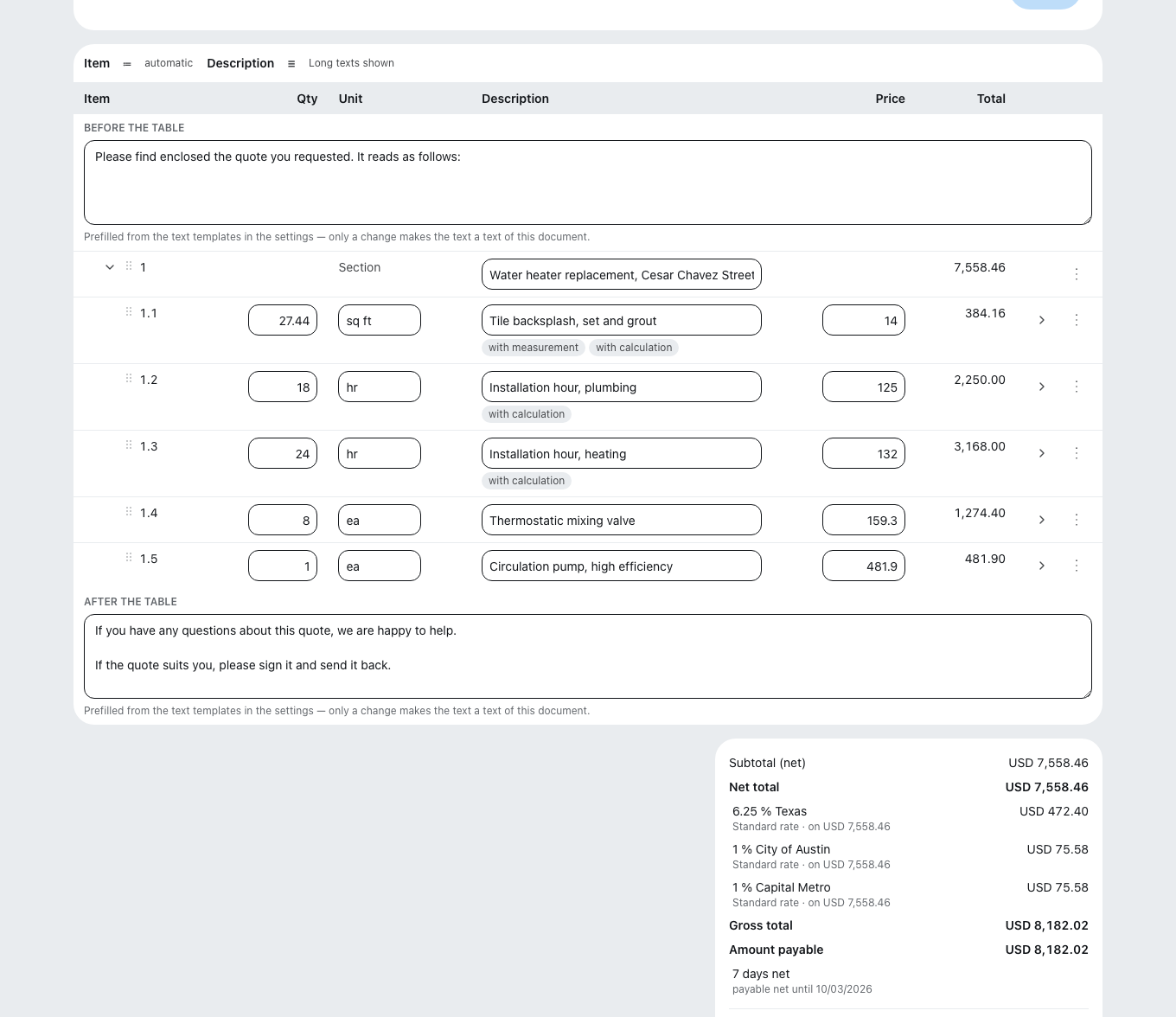
What Zirko does: it can carry interim and final documents on one job with recorded payment terms, and it puts individual positions with quantities and prices on each document, so the full value of the work stays visible even when part of the payment is withheld. Zirko does not track retainage release dates for you, does not calculate a retained balance across jobs, and does not assess your contracts. Issued documents are immutable; a correction is a separate document, so the payment history of a job stays readable.
Frequently asked questions
Is retainage capped at a national level?
No. Retainage is state law and the figures differ. Texas requires an owner to reserve 10 percent by statute; New York caps private retainage at 5 percent of the contract sum; California caps retention proceeds on public works at 5 percent with statutory exceptions.
How much retainage does Texas require?
Ten percent. Property Code § 53.101 requires the owner to reserve 10 percent of the contract price of the work, or 10 percent of the value of the work measured by the proportion that the work done bears to the work to be done, during the progress of work under an original contract for which a mechanic's lien may be claimed and for 30 days after the work under the contract is completed.
What is the New York retainage cap?
General Business Law § 756-c states that an owner may retain no more than five per centum of the contract sum as retainage, and that retainage shall be released by the owner to the contractor no later than thirty days after the final approval of the work.
What is the California public works retention cap?
Public Contract Code § 7201 provides that retention shall not exceed 5 percent of the payment, and that in no event shall the total retention proceeds withheld exceed 5 percent of the contract price. Exceptions apply where a subcontractor cannot or refuses to provide a performance and payment bond, and where the awarding body has made a documented finding before the bid that the project is substantially complex.
Does retainage reduce the amount I invoice?
No. Retainage is a deferral of part of the payment, not a reduction of the price. The invoice is for the full value of the work; the retained portion is withheld against it. Treating it as a discount misstates both the receivable and the tax position.
How does retainage interact with lien deadlines?
It often has its own clock. Texas Property Code § 53.052(d) sets a separate affidavit deadline for retainage claims — the 15th day of the third month after the month the original contract was completed, terminated or abandoned. New York Lien Law § 10 allows a lien to be filed within ninety days after the date the retainage was due to be released.
Continue reading
- Sales tax on construction: one job, three states, three answers
In Texas, labor to repair a home is not taxable and the identical work on an office building is. In New York a capital improvement is exempt, but you pay tax on the materials.
- Texas sales tax: home repair labor untaxed, office repair taxed
The same remodel is untaxed in an apartment and fully taxed in an office. New construction labor is untaxed unless remodeling exceeds five percent and is not stated separately.
- Contractor estimate: from takeoff to a price that holds
Pricing a job in the order you actually do it: quantities with units, labor split from material, markup against margin, allowances, and the change order that only counts in writing.
- Invoicing for contractors: the billing run, in order
Billing a construction job: the schedule of values, percent complete, retainage on its own line, the lien waiver that gates the check, and what actually starts the payment clock.
Sources
- Texas Property Code § 53.101 (required retainage — 10 percent, 30 days) (checked: August 29, 2026)
- New York General Business Law § 756-c (retainage cap of five per centum, release within thirty days) (checked: August 29, 2026)
- New York General Business Law § 756-a (payment within thirty days of approval; seven days down the chain) (checked: August 29, 2026)
- California Public Contract Code § 7201 (retention proceeds on public works — 5 percent, exceptions) (checked: August 29, 2026)
- Texas Property Code § 53.052 (filing of affidavit, including the retainage deadline in subsection (d)) (checked: August 29, 2026)
- New York Lien Law § 10 (lien within ninety days after retainage was due to be released) (checked: August 29, 2026)