Eighteen per cent, every time: VAT on building work in Malta
The Eighth Schedule to the VAT Act lists fifteen reduced-rate categories. Not one of them is construction, renovation or repair of a building. A kitchen refit carries 18 per cent.
Zirko RedaktionPublished: Updated: 9 min read
Contents
A contractor in Sliema quotes 12,000 euro for a full apartment refurbishment and adds VAT at 5 per cent, because a colleague told him renovation work is reduced-rated. It is not. The correct figure is 18 per cent, the difference is 1,560 euro, and the customer has already signed.
Malta is unusual among EU member states in this. Several of them charge a reduced rate on the renovation of private dwellings. Malta charges the standard rate on all of it, and the reason is not policy commentary — it is the plain content of a schedule you can read in ten minutes.
The rates, as they stand
| Rate | Legal basis | Covers |
|---|---|---|
| 18 % | article 19(1), VAT Act | everything not listed in the Eighth Schedule — including all construction, renovation and repair |
| 12 % | Eighth Schedule items 12–15 | securities custody, credit management, short pleasure-boat hire, regulated health-care body treatments |
| 7 % | Eighth Schedule items 1 and 11 | licensed accommodation, use of sporting facilities |
| 5 % | Eighth Schedule items 2–10 | electricity, listed consumable goods, medical accessories, printed matter, disability items, imported works of art, minor repairing of bicycles, shoes and clothing, domestic care, museum and concert admission |
Article 19(1) does the work in one sentence:
The tax chargeable on every taxable supply, other than a supply referred to in sub-article (2), shall be at the rate of eighteen per cent of the taxable value of the supply.
Sub-article (2) is the escape hatch, and it points only at the Eighth Schedule. It also sets the boundaries of that Schedule: no rate in it may be "higher than eighteen per cent or lower than five per cent". There is no zero-rated building work in Malta and there is no super-reduced rate.
Read the Eighth Schedule once and the question is closed
The Schedule has fifteen numbered items. In full, by subject: accommodation in licensed premises; electricity; a list of consumable goods by CN code; medical accessories by CN code; printed matter; items for the exclusive use of disabled persons; the importation of works of art, collectors' items and antiques; minor repairing of bicycles, shoes and leather goods, clothing and household linen; domestic care services; admission to museums, art exhibitions, concerts and theatres; use of sporting facilities; custody and management of securities; management of credit and credit guarantees; short hiring of a pleasure boat; and care of the human body by a regulated health professional.
Item 8 is the one that misleads people. "Minor repairing" at 5 per cent is real, and it is exhaustively defined: bicycles, shoes and leather goods, clothing and household linen. It has nothing to do with buildings.
The 12 per cent rate is newer and gets quoted loosely because it arrived recently. Legal Notice 231 of 2023 inserted items 12 to 15 with effect from 1 January 2024. Every one of them is a financial, leisure or health-care service. There is no construction item in the 12 per cent band and never has been.
Annex III to the VAT Directive, as recast by Council Directive (EU) 2022/542, does permit a member state to apply a reduced rate to the renovation, repair and transformation of housing and private dwellings. Malta has not used that permission. That is a choice, not an oversight, and until the Eighth Schedule changes it makes the pricing question simple.
What this means when you price a job
For a VAT-registered contractor working for a private customer, three things follow.
One: every line on a building quote is 18 per cent. Labour, materials, plant hire, scaffolding, waste disposal, limestone restoration, air-conditioning installation, a new membrane on a roof. There is no split and no ratio test to run, unlike Ireland or the United Kingdom. Simplicity is the compensation for the higher rate.
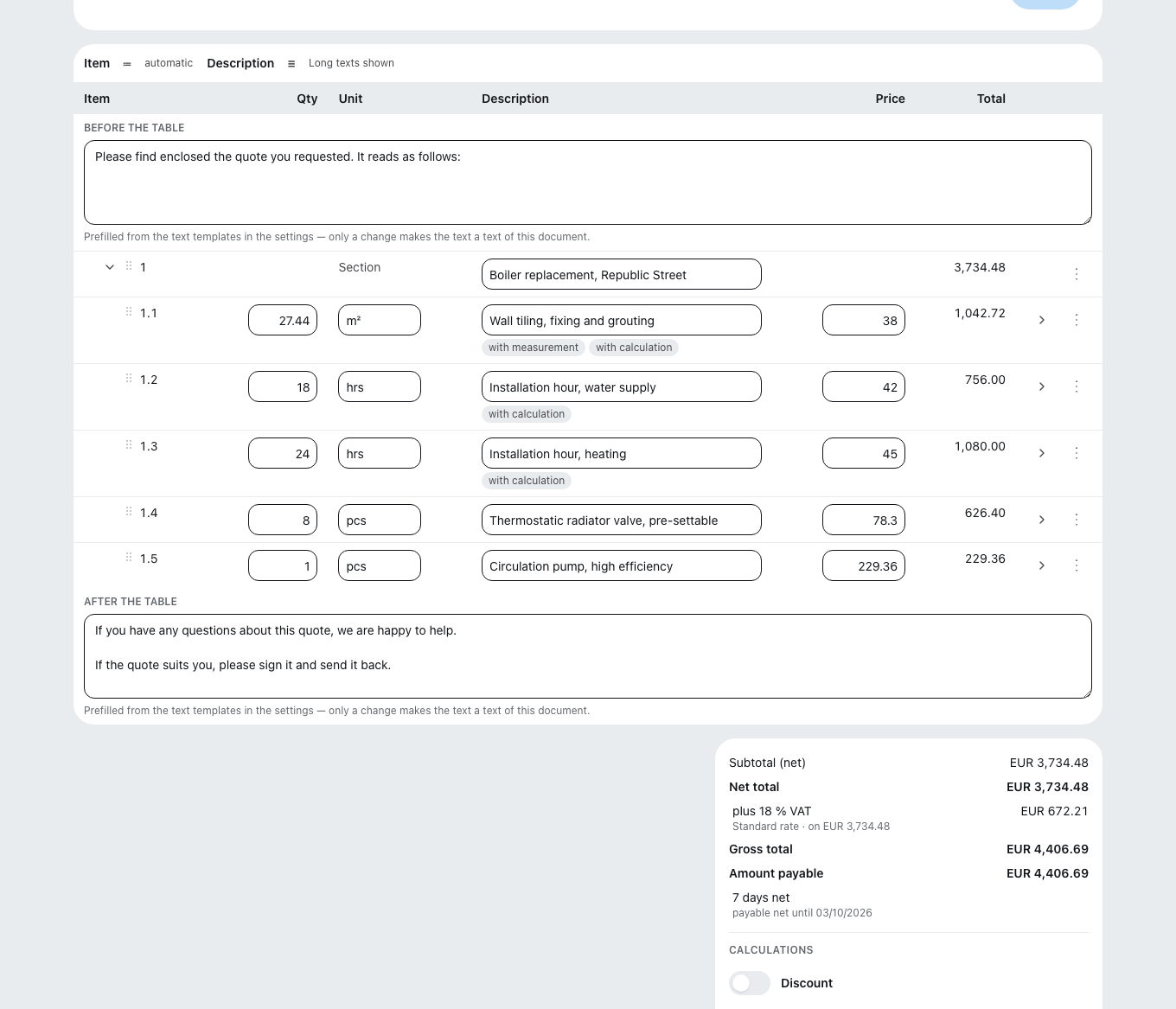
Two: quote exclusive of VAT, and say so. A homeowner who hears "twelve thousand" hears the total. Write the figure as €12,000 excluding VAT — VAT at 18 % = €2,160 — total €14,160. Three lines, one argument avoided.
Three: a supplier at 18 per cent is not a cost to you if you are registered under article 10. It is input tax. That distinction matters enormously for the next section.
The rate is only half of what has to be right on the quote. The other half is whether you may lawfully do the work at all: since 1 January 2025 demolition, excavation and construction in Malta each need a licence from the Building and Construction Authority, which is set out in The BCA contractor licence in Malta: three activities, two years.
The 35,000 euro line, and the day you cross it
There is no turnover threshold for being a taxable person in Malta. The threshold decides only whether you may use the small enterprise exemption in article 11.
Item 5 of the Sixth Schedule sets it:
"Domestic threshold" means the threshold fixed in Malta in accordance with Article 284(1) of Council Directive 2006/112/EC which shall be an amount equivalent to thirty-five thousand euro (€35,000).
Registered under article 11, you charge no VAT and you deduct no input tax. Registered under article 10, you charge 18 per cent and recover the VAT on materials, tools, van fuel and subcontractors.
What an article 11 registration does not do is release you from documenting the work. A small enterprise still issues fiscal receipts and still keeps copies of them for six years; the reasons are in The VAT book in Malta: fiscal receipt or tax invoice. Which of the two registrations is cheaper for your own customer mix is worked through with figures in Article 11 VAT in Malta, or Article 10: which is cheaper.
For a trade with heavy material content, the arithmetic frequently favours article 10 even below the threshold. A contractor turning over 30,000 euro with 12,000 euro of material purchases is carrying roughly 1,830 euro of irrecoverable input tax as an article 11 business. Against a commercial customer who recovers VAT anyway, article 10 costs that customer nothing and saves the contractor the 1,830. Against private customers only, article 11 keeps your price 18 per cent lower than a registered competitor's. The right answer depends on who your customers are, not on how big you are.
Three provisions decide the timing, and they are stricter than most people expect:
- Item 3 of Part One of the Sixth Schedule: a person "shall no longer qualify as a small enterprise on the date the Domestic threshold is exceeded within a calendar year". Not at year end. On the day.
- Article 11(5)(b): apply for cancellation of the article 11 registration "within fifteen (15) days from the date on which such person no longer qualifies".
- Article 11(2), first proviso: a person coming in from an article 10 registration can only move to article 11 from the first day of the month following the application — and item 2(1) of Part One blocks the move entirely during the first twelve calendar months of an article 10 registration.
The practical consequence is that the threshold has to be watched during the year, not reconstructed after it. One large commercial job in November can push a 30,000 euro business over the line, and the fifteen days run from that invoice, not from January.
There is also a cross-border version. Item 7 of the Sixth Schedule sets a Union threshold of 100,000 euro, and article 11A lets a Malta-established small enterprise use the exemption in another member state's own small-enterprise scheme, subject to prior notification and to that state's own threshold.
The trap that costs the most: building to sell
Item 1(2) of Part Two of the Fifth Schedule is nine words long:
The transfer of immovable property.
It sits in the list of exempt without credit supplies. A contractor who buys a shell, converts it and sells the finished apartment makes an exempt supply on the sale. No output tax — and no input tax deduction on the 18 per cent he was charged by his own suppliers and subcontractors along the way.
The same schedule exempts the letting of immovable property, with carve-outs: licensed tourist accommodation, designated parking areas, permanently installed equipment, letting by a limited liability company to an article 10 registered person for that person's economic activity, and short lettings of up to thirty days by a taxable person, each with its own conditions.
The distinction to hold on to is this. Selling a building is exempt. Building it for someone else is 18 per cent. A firm that does both has a partial attribution problem and needs the input tax apportioned under the Tenth Schedule. A firm that only ever invoices construction services does not.
A short checklist
- Price at 18 per cent and quote exclusive of VAT. There is no reduced rate to argue about, so the only remaining risk is a quote the customer read as inclusive.
- Never rely on "minor repairing" for building work. Item 8 is bicycles, shoes, clothing and household linen. Read it before quoting it.
- Track turnover against 35,000 euro month by month if you are registered under article 11, and diarize the fifteen-day cancellation duty against the invoice that crosses the line.
- Count your irrecoverable input tax before choosing article 11. For a material-heavy trade selling to businesses, the exemption is usually the more expensive option.
- Treat a build-and-sell project as a separate question. The sale is exempt without credit; the VAT you paid on the way is a cost, not a credit.
---
Position as at 6 September 2026. This article describes the law and is not tax advice. The rates and thresholds are taken from the consolidated Value Added Tax Act (Chapter 406) as published on legislation.mt on the date shown; the Eighth Schedule is amended by legal notice from time to time, most recently by L.N. 231 of 2023 and L.N. 354 of 2024, so check it against the current consolidation before you rely on it.
What Zirko does here: a quote and an invoice hold the rate that applied on the day they were issued, so a future change to the Eighth Schedule cannot rewrite a document you have already sent. Zirko does not decide whether you should be registered under article 10 or article 11 — that is a decision about your customers, and it belongs to you and your accountant.
Frequently asked questions
What is the standard rate of VAT in Malta?
Eighteen per cent. Article 19(1) of the Value Added Tax Act (Chapter 406) provides that the tax chargeable on every taxable supply, other than a supply referred to in sub-article (2), shall be at the rate of eighteen per cent of the taxable value of the supply. Article 19(2) sends the exceptions to the Eighth Schedule, and article 19(2) also fixes the outer limits: no rate in that Schedule may be higher than eighteen per cent or lower than five per cent.
Is there a reduced VAT rate for renovation work in Malta?
No. The Eighth Schedule to the Value Added Tax Act lists fifteen categories at 12, 7 or 5 per cent: accommodation, electricity, certain consumable goods, medical accessories, printed matter, items for the exclusive use of the disabled, imported works of art, minor repairing of bicycles, shoes and clothing, domestic care services, admission to museums and concerts, use of sporting facilities, custody and management of securities, management of credit, short hiring of a pleasure boat and care of the human body by a regulated health professional. Construction, renovation and repair of buildings appear nowhere in it, so the standard rate of eighteen per cent applies.
What is the 12 per cent VAT rate in Malta for?
Four things, added to the Eighth Schedule by Legal Notice 231 of 2023 with effect from 1 January 2024: custody and management of securities; management of credit and credit guarantees by a person or body other than the one that granted the credit; the hiring of a pleasure boat for a period that, added to previous hirings of the same or similar goods to the same person in the preceding twelve months, does not exceed five weeks; and services consisting of the care of the human body delivered by a person exercising a profession regulated by the Health Care Professions Act. None of them is a construction service.
When must a Maltese tradesman register for VAT under article 10?
There is no turnover threshold for being a taxable person. The 35,000 euro figure is the threshold for the small enterprise exemption under article 11, defined in item 5 of the Sixth Schedule as the threshold fixed in Malta in accordance with Article 284(1) of Council Directive 2006/112/EC. A taxable person whose domestic annual turnover in the preceding calendar year was not more than that amount may apply for an article 11 registration; anyone else registers under article 10 and charges VAT.
What happens on the day I go over 35,000 euro?
Item 3 of Part One of the Sixth Schedule states that a person registered under article 11 shall no longer qualify as a small enterprise on the date the domestic threshold is exceeded within a calendar year. Article 11(5)(b) then requires that person to apply to the Commissioner for cancellation of the article 11 registration within fifteen days from that date. Article 11(8) allows the Commissioner to register the person under article 10 immediately upon cancellation.
Should I register for VAT under article 10 or article 11 in Malta?
It depends on who your customers are, not on how big you are. Under an article 11 registration you charge no VAT and deduct no input tax; under article 10 you charge 18 per cent and recover the VAT on materials, tools, fuel and subcontractors. For a material-heavy trade selling to VAT-registered businesses, article 10 is usually the cheaper option — a contractor turning over 30,000 euro with 12,000 euro of material purchases carries roughly 1,830 euro of irrecoverable input tax as an article 11 business. Selling to private customers only, article 11 keeps your price 18 per cent below a registered competitor's.
Do I charge VAT when I build a property to sell it?
The transfer of immovable property is an exempt without credit supply under item 1(2) of Part Two of the Fifth Schedule to the VAT Act. No output tax is charged on the sale, and input tax attributable to that exempt supply is not deductible. The construction services you buy in to do the work are still charged to you at eighteen per cent, and that VAT is a cost rather than a credit.
Continue reading
- Article 11 VAT in Malta, or Article 10: which is cheaper
Malta's small undertaking exemption has had one threshold since January 2025, not three. Which registration is cheaper depends on who signs your quotes, not on how big you are.
- Debt collection in Malta: interest, costs and the judicial letter
10.40 per cent for the second half of 2026 plus forty euro of costs, with no reminder required — then the judicial letter, and the step after it that most summaries leave out.
- The VAT book in Malta: fiscal receipt or tax invoice
Order a VAT book from the tax administration and collect it at MaltaPost — you cannot buy one on a Friday. A registered customer gets a tax invoice, everyone else a fiscal receipt.
- VAT number and VAT certificate in Malta: what each is for
A Maltese trade business can hold a registration number that is not a valid EU VAT identification number. On an order from Sicily that distinction costs hundreds of euro.
Sources
- Value Added Tax Act (Chapter 406), article 19 and the Eighth Schedule - rate of tax (checked: 06 September 2026)
- Value Added Tax Act (Chapter 406), Sixth Schedule - small enterprises, domestic threshold and Union threshold (checked: 06 September 2026)
- Value Added Tax Act (Chapter 406), Fifth Schedule Part Two - exempt without credit supplies, immovable property (checked: 06 September 2026)
- Council Directive (EU) 2022/542 of 5 April 2022 amending the reduced rate rules and Annex III to Directive 2006/112/EC (checked: 06 September 2026)