Debt collection in Malta: interest, costs and the judicial letter
10.40 per cent for the second half of 2026 plus forty euro of costs, with no reminder required — then the judicial letter, and the step after it that most summaries leave out.
Zirko RedaktionPublished: Updated: 15 min read
Contents
- Which customers this covers, and which it does not
- When the money is late, if the contract says nothing
- Public authorities: thirty days, sixty in two named cases
- The rate, and why the September rise did not change it
- Forty euro, and the part of article 26E that gets left off
- A clause saying "no interest" is void before you argue about it
- The judicial letter, and the step almost every summary leaves out
- One debt, from invoice to register
On a Maltese commercial debt that ran late in the second half of 2026 the statutory rate is 10.40 per cent a year, and you may add forty euro of recovery costs. Neither needs a reminder first. The European Central Bank raised its main refinancing rate on 16 September 2026, and that did not change your figure — article 26C(5) of the Commercial Code takes the reference rate in force on 1 July and holds it until 1 January.
Malta did not put the EU late payment directive into a stand-alone regulation. It went into the Commercial Code (Chapter 13) itself, as Sub-title IA of Title II, articles 26A to 26J, in the form substituted by the Commercial Code (Amendment) Order, 2014 — L.N. 13 of 2014, which also added articles 26I and 26J. That placement is the practical point: these are default rules of Maltese commercial law, they apply "notwithstanding the provisions of any other law" to transactions carried out "as from 1st March, 2012", and none of them has to be written into your contract to work.
Which customers this covers, and which it does not
Article 26B sets the scope: payments as remuneration for commercial transactions "carried out between private and public undertakings, between undertakings and public authorities, and between main contractors and their suppliers and subcontractors".
That last limb is written for construction. A subcontractor chasing a main contractor is squarely inside these rules. The same pair meets again on the licensing side, where the firm that engages the workers and the firm that executes the work each need their own licence from the Building and Construction Authority — The BCA contractor licence in Malta: three activities, two years.
Outside, by the proviso to article 26B: transactions between consumers, interest under the laws on cheques and bills of exchange, and payments made as compensation for damages, including payment from insurance companies. So the regime splits your customer book in two. Work for a homeowner is not a commercial transaction and none of this reaches it; work for a developer, a hotel, a facilities company, a landlord trading as a business, a local council or a government department is, and all of it does.
"Undertaking" is defined broadly in article 26A: any body other than a public authority acting in the course of its independent economic or professional activity, "even where that activity is carried out by a single person". A one-man contractor is an undertaking. Being registered as a small undertaking for VAT purposes does not take you out of it either — the two regimes are independent of one another, and which VAT registration you hold is a separate question, settled in Article 11 VAT in Malta, or Article 10: which is cheaper.
When the money is late, if the contract says nothing
Article 26C(3) gives the default. Where no date or term for payment is fixed, the creditor is entitled to interest on the expiry of whichever of these applies.
| Trigger | Period | Legal basis |
|---|---|---|
| Receipt of the invoice by the debtor | 30 calendar days | art. 26C(3), proviso (a) |
| Receipt of the goods or services, where the date of receipt of the invoice is uncertain | 30 calendar days | art. 26C(3), proviso (b) |
| Receipt of the goods or services, where the debtor received the invoice earlier | 30 calendar days | art. 26C(3), proviso (c) |
| The date on which the goods or services must be ascertained or verified, where the invoice came earlier or on that date | 30 calendar days | art. 26C(3), proviso (d) |
Where the contract does fix a date, article 26C(3) entitles the creditor to interest "from the day following the date or the end of term for payment fixed in the contract". There is no grace period.
One qualification that is easy to miss, because it sits in a second proviso: the parties may expressly agree to extend the thirty-day period under paragraph (d) only — the verification case — to a longer one, so long as the extension is not grossly unfair to the creditor. The other three triggers carry no such licence.
And the ceiling, in article 26C(4):
Irrespective of any other law, the period for payment fixed in a contract may not exceed sixty calendar days: Provided that the parties may expressly agree for a longer period, so long as the extension of time is not grossly unfair to the creditor.
Ninety- and 120-day terms are ordinary in construction across Europe. In Malta they are lawful only if expressly agreed and not grossly unfair, and the test for that is set out further down.
Three of the four default triggers run from the debtor's receipt of something, so the document is what starts the clock — which is a reason to issue it on the day rather than at month end. Which document a Maltese customer is owed is decided by his VAT status rather than yours: The VAT book in Malta: fiscal receipt or tax invoice.
Public authorities: thirty days, sixty in two named cases
Article 26D runs the same structure where a public authority is the debtor — the same four thirty-day triggers, the same right to claim without a reminder. Its proviso adds three things worth knowing before you tender for public work. The acceptance or verification procedure itself may not exceed thirty calendar days unless expressly agreed in the contract and in all tender documents. An expressly agreed payment period, objectively justified by the particular nature or features of the contract, may not exceed sixty calendar days. And the periods extend to a maximum of sixty days for a public authority carrying out economic activities of an industrial or commercial nature subject to Commission Directive 2006/111/EC, and for public entities providing health care that are duly recognised for that purpose.
Article 26D(4) then closes a familiar loophole in one line: "An agreement between the creditor and debtor extending the date of receipt of the invoice is null and void." A tender condition treating an invoice as received only once a project manager has signed it off does not move the clock.
The rate, and why the September rise did not change it
Article 26A defines legal interest for late payment as "simple interest for late payment at a rate which is equal to the sum of the reference rate and at least eight percent (8%)", the reference rate being the one the European Central Bank applies to its most recent main refinancing operations. Article 26C(5) then fixes which reference rate governs which half of the year: the rate in force on 1 January for the first semester, the rate in force on 1 July for the second. That semester rule is the part summaries get wrong, because it means the current ECB rate is usually not the one you may charge.
| Period | ECB reference rate | Legal interest | How it is fixed |
|---|---|---|---|
| 1 Jan – 30 Jun 2026 | 2.15 % (in force since 11 June 2025) | 10.15 % | art. 26A + art. 26C(5)(a) |
| 1 Jul – 31 Dec 2026 | 2.40 % (in force since 17 June 2026) | 10.40 % | art. 26A + art. 26C(5)(b) |
| from 1 Jan 2027 | 2.65 % if still in force on that day (raised 16 September 2026) | 10.65 % on that assumption | art. 26A + art. 26C(5)(a) |
A debt that ran late in May 2026 and is still unpaid therefore carries two rates, not one: 10.15 per cent up to 30 June and 10.40 per cent from 1 July. The ECB's move on 16 September changes nothing until 1 January 2027, and then only if it is still standing that day.
Two limits belong in the same breath. "At least eight percent" is a floor, not a fixed margin — a contract may agree a higher one, and article 26G only bites where the agreed rate is grossly unfair to the creditor. And the statute does not prescribe a day-count convention; the worked example below counts actual days over a 365-day year, which is the ordinary commercial practice, not a rule of the Code.
One thing the interest is calculated on surprises people. "Amount due" is defined in article 26A as the principal "including, where applicable, taxes, duties, levies or charges specified in the invoice" — so interest runs on the VAT-inclusive total, not on the net. On building work in Malta that is an eighteen per cent difference in the base, for the reason set out in Eighteen per cent, every time: VAT on building work in Malta. Article 26J puts the duty to publish the rate of legal interest, including by electronic means, on the Ministry for Finance.
Forty euro, and the part of article 26E that gets left off
In addition to the claim for late payment under this Sub-Title, a creditor is entitled to recover from the debtor, without the need of a reminder: (a) a minimum of forty euro (€40) as compensation for the creditor's own recovery costs; and (b) such other reasonable sum in excess of the forty euro (€40) incurred by him due to the debtor's late payment.
Paragraph (b) is the one that is usually dropped when this provision is summarised, and it is the one that matters on a real debt. The forty euro is a floor, not a cap. Reasonable costs actually incurred above it — the court fee for a judicial letter, a legal procurator's drafting fee — are recoverable on top of it.
A clause saying "no interest" is void before you argue about it
Article 26G(3) is unusually blunt for a code provision:
For the purpose of this article, a provision in a contract or a practice which excludes: (a) interest for late payment, shall be deemed as grossly unfair; (b) compensation for recovery costs, shall be presumed to be grossly unfair.
"Deemed" in (a) admits no rebuttal. "Presumed" in (b) shifts the burden onto whoever wants to defend the clause. Under article 26G(1) such a provision, or a practice relating to the date or period of payment, the rate of interest or the recovery-cost compensation, may be unenforceable or may give rise to a claim for damages. Article 26G(2) lists what weighs in that judgment: gross deviation from good commercial practice contrary to good faith or fair dealing, the nature of the product or service, and whether the debtor has any objective reason to deviate.
The practical reading is that a payment clause pushed on you by a main contractor is not binding merely because you signed it. That is unusual, and it is the strongest card a Maltese subcontractor holds. Article 26G(4) adds a collective route: an organisation representing enterprises, or with a legitimate interest in representing them, may go to a court of civil jurisdiction against manifestly unjust conditions or practices.
Two shorter provisions sit alongside it. Article 26F allows payment by instalments and then protects you: where an instalment is missed, "the payment of interest and compensation shall be calculated solely on the basis of overdue amounts". A stage-payment schedule therefore produces a separate late payment on each missed stage; it does not put the whole contract in dispute, and it does not postpone the interest on stage two until stage five falls due. Article 26H makes a retention of title agreement effective until the price has been paid in full — a narrow tool once material is built in, but one paragraph well spent by a firm that supplies joinery, doors or plant ahead of installation.
The judicial letter, and the step almost every summary leaves out
Article 26I points an undisputed late-payment claim at a procedure most small firms do not know exists: an executive title "according to the provisions of articles 166A to 170, inclusive, of the Code of Organization and Civil Procedure".
Article 166A of Chapter 12 applies to the recovery of "a debt certain, liquidated and due not consisting in the performance of an act" where the amount does not exceed twenty-five thousand euro, "or such other sum as may be established from time to time by Order in the Gazette by the Minister" — a movable figure, worth checking rather than remembering. Above it the creditor may still use the procedure by limiting the claim to that sum and expressly renouncing any excess on liquidation. It is open only where the debtor is present in Malta, is not a minor or a person incapacitated at law, and the debt is not due by a vacant inheritance.
The creditor files a judicial letter in the form established by legal notice, its content confirmed on oath, stating clearly and under pain of nullity the cause of the claim, the reasons it should be upheld and a statement of facts. It must also carry, again on pain of nullity, an intimation that if the debtor does not reply within thirty days of service by filing a note rebutting the claim, the letter shall constitute an executive title. The note may be signed and filed by the debtor himself, without an advocate or legal procurator. A claim opposed in part only "shall be deemed admitted to the extent that it has not been so opposed". Costs of a claim opposed and later upheld fall on the debtor; costs of a claim opposed and not upheld always fall on the creditor. And where the debtor duly opposes, the procedure may not be used against him again on the same claim.
Then comes article 166B, and it is the step that turns a widely repeated half-truth into a wrong one. Thirty days of silence do not by themselves hand you an enforceable title:
A judicial letter issued in terms of article 166A shall not constitute an executive title unless it is registered according to the provisions of this article.
Registration is a separate act. The creditor presents to the Registrar of the Court a legal copy of the judicial letter, evidence of service, and a copy of any response received. The Registrar examines them, verifies whether the debtor filed a note of reply in time, and if satisfied, enters the documents in the Register of Judicial Letters as Executive Titles. Only then is there something to execute.
Two deadlines run alongside, both of which end the procedure quietly if missed. Under article 166A(7), a judicial letter not notified on the debtor within six months of being filed loses the benefit of the procedure — the creditor may file a fresh one on the same claim, but the first has lapsed. And under article 166A(5) the debtor has twenty days from the first service of an executive warrant to apply to the Court of Magistrates to have the title rescinded, on two grounds only: that he was not duly notified, or that the letter did not contain the requirements of sub-articles (1), (2) or (3). Those requirements are the reason the drafting is worth paying for.
What it costs is small and public. Schedule A, Tariff B item 1 charges €15 for filing a judicial letter generally and €30 where it is required under article 166A. Drafting is a legal procurator's fee: €23.29 under Tariff E item 6(a), but the proviso to that item sets the fee for a 166A letter that becomes an executive title at 40 per cent of the amount fixed in article 13 of the same Tariff — the scale that begins at €46.59, or ten per cent, whichever is the greater, for the first €1,164.69 of value — reduced to 30 per cent where the debtor files a note admitting the claim. All of it is a reasonable sum incurred due to the debtor's late payment, and therefore recoverable under article 26E(b).
One debt, from invoice to register
An electrician finishes a fit-out for a developer and invoices €9,000 including VAT. The contract says nothing about payment terms. The developer receives the invoice on 3 April 2026.
- 3 May 2026 — thirty calendar days from receipt expire, under the proviso (a) to article 26C(3).
- 4 May 2026 — interest starts, from the day following. The rate is 10.15 per cent, the first-semester figure.
- 1 July 2026 — the rate becomes 10.40 per cent for the same unchanged debt, because article 26C(5)(b) substitutes the reference rate in force on that day.
- 26 September 2026 — 58 days at 10.15 per cent is €145.16; 88 days at 10.40 per cent is €225.67. With the €40 under article 26E the claim stands at €9,410.83, and not one reminder has been sent, because articles 26C(2) and 26E do not require one.
- The same week — the debt is certain, liquidated, due and under €25,000, so a judicial letter under article 166A is available for €30 in court fees plus the drafting fee.
- Thirty days after service — if no note rebutting the claim is filed, the letter qualifies as an executive title, and the creditor presents it with evidence of service to the Registrar for entry in the register under article 166B.
The arithmetic is not a fortune. What it changes is the position of a debtor who was treating the invoice as a free overdraft, and it does so without a single negotiation having taken place.
---
Position as at 26 September 2026. This article describes the law and is not legal advice. Articles 26A to 26J of the Commercial Code and articles 166A and 166B of the Code of Organization and Civil Procedure are quoted from the consolidated texts published on legislation.mt, the Chapter 13 text as at its point in time of 27 January 2026. Two figures here will move on a known date rather than at random: the legal interest rate is re-fixed every 1 January and 1 July from the ECB reference rate in force on that day, so check the semester before you put a number in a demand, and the €25,000 ceiling in article 166A may be changed by Order in the Gazette.
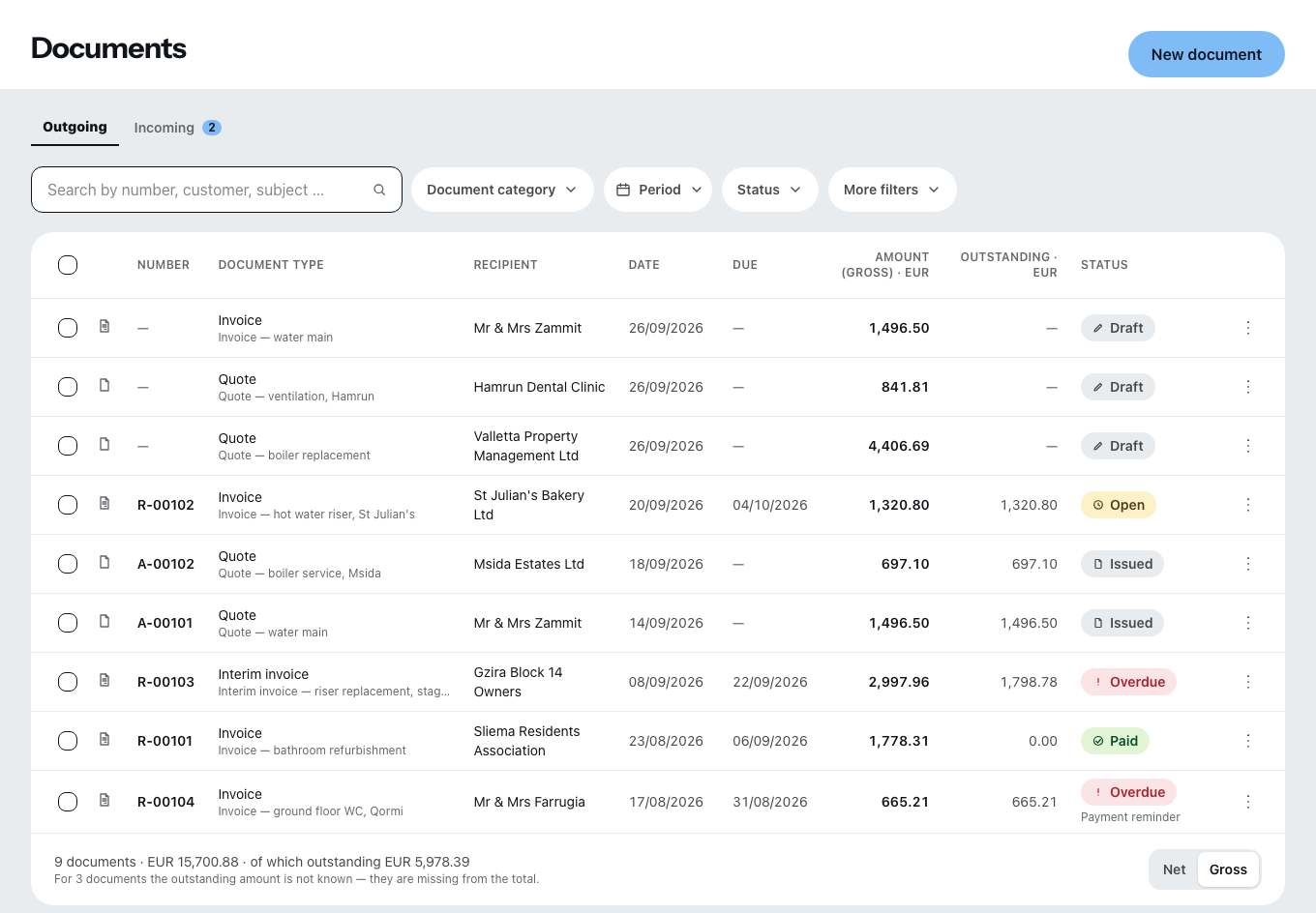
What Zirko does here: an invoice carries its own due date and its own outstanding amount, so an overdue list is a fact rather than a memory, and a dunning level can carry an interest rate and a fee that go onto the letter. Zirko does not hold a statutory rate for Malta — only Germany, Austria and Switzerland have one stored, and nothing is guessed for the others, so the Maltese semester figure is one you enter yourself. It does not draft judicial letters or register executive titles either; that is a legal procurator's work and a Registrar's.
Frequently asked questions
What interest can I charge on a late invoice in Malta?
The reference rate plus at least eight per cent. Article 26A of the Commercial Code defines legal interest for late payment as simple interest at the sum of the reference rate and at least eight per cent, the reference rate being the one the European Central Bank applies to its most recent main refinancing operations. Article 26C(5) fixes it per semester, so the figure for the second half of 2026 is 10.40 per cent.
Do I have to send a reminder before charging interest in Malta?
No. Article 26C(2) of the Commercial Code says the creditor may proceed with the claim of interest for late payment without reminding the debtor that the amount is due. Article 26D(2) repeats it for public authorities, and article 26E allows the forty euro of recovery costs to be claimed without a reminder as well. A reminder is a commercial courtesy in Malta, not a legal precondition.
How long may a Maltese customer take to pay?
Thirty calendar days where the contract fixes nothing, under the proviso to article 26C(3), running from receipt of the invoice or of the goods or services depending on which applies. Where the contract does fix a date, interest runs from the day following it. Article 26C(4) caps a contractual payment period at sixty calendar days unless a longer one is expressly agreed and is not grossly unfair to the creditor.
Is a contract clause excluding late payment interest valid in Malta?
No. Article 26G(3)(a) of the Commercial Code provides that a provision in a contract or a practice which excludes interest for late payment shall be deemed grossly unfair. A clause excluding the compensation for recovery costs is presumed grossly unfair under 26G(3)(b). Under article 26G(1) such a provision may be unenforceable or may give rise to a claim for damages.
What does a judicial letter under article 166A cost in Malta?
Thirty euro to file. Schedule A, Tariff B, item 1 of the Code of Organization and Civil Procedure charges fifteen euro for a judicial letter generally, and thirty where it is required under article 166A. Drafting is a legal procurator's fee: €23.29 under Tariff E item 6(a), but where the letter becomes an executive title the proviso to that item sets it at forty per cent of the article 13 scale, or thirty per cent if the debtor files a note admitting the claim.
Does thirty days of silence really give me an executive title?
Not on its own. Article 166A(3) provides that the judicial letter shall constitute an executive title if the debtor files no note rebutting the claim within thirty days of service. Article 166B then adds that it shall not constitute one unless it is registered: the creditor presents a legal copy, evidence of service and any reply to the Registrar, who enters it in the Register of Judicial Letters as Executive Titles.
Continue reading
- The VAT book in Malta: fiscal receipt or tax invoice
Order a VAT book from the tax administration and collect it at MaltaPost — you cannot buy one on a Friday. A registered customer gets a tax invoice, everyone else a fiscal receipt.
- VAT number and VAT certificate in Malta: what each is for
A Maltese trade business can hold a registration number that is not a valid EU VAT identification number. On an order from Sicily that distinction costs hundreds of euro.
- The BCA contractor licence in Malta: three activities, two years
Since 1 January 2025 nobody in Malta may demolish, excavate or build without a licence from the Building and Construction Authority. L.N. 166 of 2023 sets the classes by headcount.
- Article 11 VAT in Malta, or Article 10: which is cheaper
Malta's small undertaking exemption has had one threshold since January 2025, not three. Which registration is cheaper depends on who signs your quotes, not on how big you are.
Sources
- Commercial Code (Chapter 13), Sub-title IA — Of Late Payments in Commercial Transactions, articles 26A to 26J (consolidated text, point in time 27 January 2026) (checked: 26 September 2026)
- Code of Organization and Civil Procedure (Chapter 12), articles 166A and 166B, and Schedule A, Tariff B item 1 and Tariff E items 6 and 13 (checked: 26 September 2026)
- L.N. 13 of 2014 — Commercial Code (Amendment) Order, 2014, Government Gazette of Malta No. 19,196 of 17 January 2014, which substituted articles 26A to 26H and added articles 26I and 26J (checked: 26 September 2026)
- European Central Bank — key ECB interest rates, main refinancing operations (fixed rate) (checked: 26 September 2026)