The VAT domestic reverse charge: when your invoice shows no VAT
Since 1 March 2021 a subcontractor billing a VAT-registered contractor for CIS work charges no VAT at all — the customer accounts for it. Four questions decide whether it applies.
Zirko RedaktionPublished: Updated: 9 min read
Contents
If you are a subcontractor invoicing a VAT-registered contractor for work that is reported under CIS, your invoice shows no VAT. Not zero-rated, not exempt — no VAT charged at all, with a note telling the customer that they must account for it instead.
This has been the law for supplies with a tax point on or after 1 March 2021. Five years on it still produces two recurring errors: subcontractors who keep adding 20 per cent, and subcontractors who apply the reverse charge to a customer it was never meant for.
Why it exists
The legal machinery is section 55A of the Value Added Tax Act 1994, and the services caught by it are specified by The Value Added Tax (Section 55A) (Specified Services and Excepted Supplies) Order 2019, SI 2019 No. 892, which came into force on 1 October 2019. Article 4 of the Order specifies "construction services as defined in articles 5 to 7 together with any goods supplied with those services which fall to be treated as part of a single supply of services".
HMRC's own manual states the purpose without decoration: the measure is designed "to counter criminal attacks on the UK VAT system" including missing trader fraud in the construction sector. The fraud pattern is a supplier who charges VAT, is paid it, and disappears before paying it over. If nobody charges VAT down the chain, there is nothing to disappear with.
The four questions
Work through them in order. All four must be yes.
- Is the supply within the scope of CIS as a construction operation? The reverse charge list is the same list as CIS construction operations, with one carve-out noted below.
- Is it standard-rated or reduced-rated? Zero-rated supplies are outside.
- Is your customer VAT registered in the UK?
- Will your customer report the payment under CIS?
If any answer is no, you charge VAT in the normal way.
The list, and what falls off it
HMRC's guidance covers:
- constructing, altering, repairing, extending, demolishing or dismantling buildings or structures;
- the same operations on any works forming, or planned to form, part of the land;
- installing systems for heating, lighting, air conditioning, ventilation, power, drainage, sanitation, water supply and fire protection;
- "internal cleaning of buildings and structures, so far as carried out in the course of their construction, alteration, repair, extension or restoration";
- painting or decorating interior or exterior surfaces;
- ancillary services: site clearance, excavation, scaffolding erection, landscaping and access works.
Outside it: oil and natural gas extraction, mineral extraction, manufacturing and delivering building materials, components or equipment, professional services of architects, surveyors and consultants, artistic works, signwriting and signboards, and installing seating, blinds, shutters or security systems.
One difference from CIS matters if you use agency labour. Supplies of workers by an employment business are not subject to the reverse charge, even though they sit within the CIS scope. Employment businesses charge VAT in the normal way.
End users and intermediary suppliers
This is where money actually goes wrong, and it goes wrong quietly.
An end user is, in HMRC's words, a VAT and CIS registered business that does "not make onward supplies of the building and construction services that you receive". A property owner having its own building fitted out is the everyday example. An intermediary supplier is a registered business "connected or linked to end users" that buys and re-supplies construction services "without making material changes to the supplies".
The reverse charge does not apply to supplies to either of them — but only if they tell you. HMRC's technical guide puts the burden on the customer: the reverse charge does not apply where the customer notifies the supplier in writing of its end user or intermediary supplier status. The notification can be "by post", "by email", or "in a contract".
Two practical consequences:
- Get the wording into the contract. A standing clause is a valid written notification and saves an email hunt on every job.
- If nobody has told you anything, and the other three questions are yes, apply the reverse charge. Waiting for a notification that never comes is not a defence.
What the invoice has to show
HMRC requires two things on a reverse charge invoice:
- a clear note making it apparent that "the domestic reverse charge applies and that the customer is required to account for the VAT", and
- "how much VAT is due under the reverse charge, or if this amount cannot be shown, state the rate of VAT".
The VAT figure is shown for information. It is not added to the total the customer pays.
A worked example, standard rate:
| Line | Amount |
|---|---|
| Labour and materials, first floor rewire | £4,200.00 |
| VAT | £0.00 |
| Total payable | £4,200.00 |
| Reverse charge: customer to account to HMRC for VAT at 20 % | £840.00 |
The 840 pounds never reaches your bank account, and it never leaves it either. Your customer puts it in box 1 of their return and, where entitled, reclaims it in box 4.
The two rules that stop you slicing contracts
The 5 per cent disregard. Where reverse charge supplies are 5 per cent or less of the value of the whole contract, that element "can be disregarded" and normal VAT rules apply — but only if both parties agree from the outset of the contract. It is a simplification for mixed contracts, not a planning tool you apply retrospectively.
Once it applies, it applies to the whole contract. Where two separate contracts are "linked, with both to be carried out on the same site, the reverse charge will apply to both contracts". Splitting a job into a reverse-charge half and a non-reverse-charge half does not work when they are one supply for VAT purposes.
And one more: "The reverse charge does not apply to standard-rated items which are included in a zero-rated supply of building and construction services." New-build residential work that is zero-rated stays zero-rated throughout, including the standard-rated items inside it.
What it does to your cash flow
This is the part nobody warns subcontractors about. Under the old rules you collected 20 per cent from your customer and held it until the quarter end. That was never your money, but it sat in your account and it smoothed a lot of weeks.
Under the reverse charge you collect none of it, while still paying VAT on your own purchases. Many subcontractors move from paying HMRC each quarter to reclaiming from HMRC each quarter. That shift is also what breaks the Flat Rate Scheme for most subcontractors — which scheme actually fits reverse-charge work instead is set out in flat rate, cash accounting or neither: choosing a VAT scheme.
Two things follow:
- Consider monthly VAT returns if you are now in a repayment position. Waiting three months for a refund you are owed is a choice, not a requirement.
- Re-forecast. If your cash plan was built when 20 per cent of every invoice landed in your account first, it is out of date.
A short checklist
- Ask every VAT-registered customer, once, in writing, whether they are an end user or intermediary supplier, and keep the answer.
- Put the reverse charge wording in your invoice template, not into each invoice by hand.
- Check the rate before you check anything else. Zero-rated new build takes the whole question away.
- Do not reverse charge a private customer. Householders are not VAT registered and do not report under CIS; normal rules apply.
- Look at your VAT position for the last four quarters. If you are now in repayment, monthly returns may be worth the extra filing.
---
Position as at 29 August 2026. This article describes the law and is not tax advice. HMRC's guidance on this measure has been amended several times; the pages cited below carry the date on which they were checked.
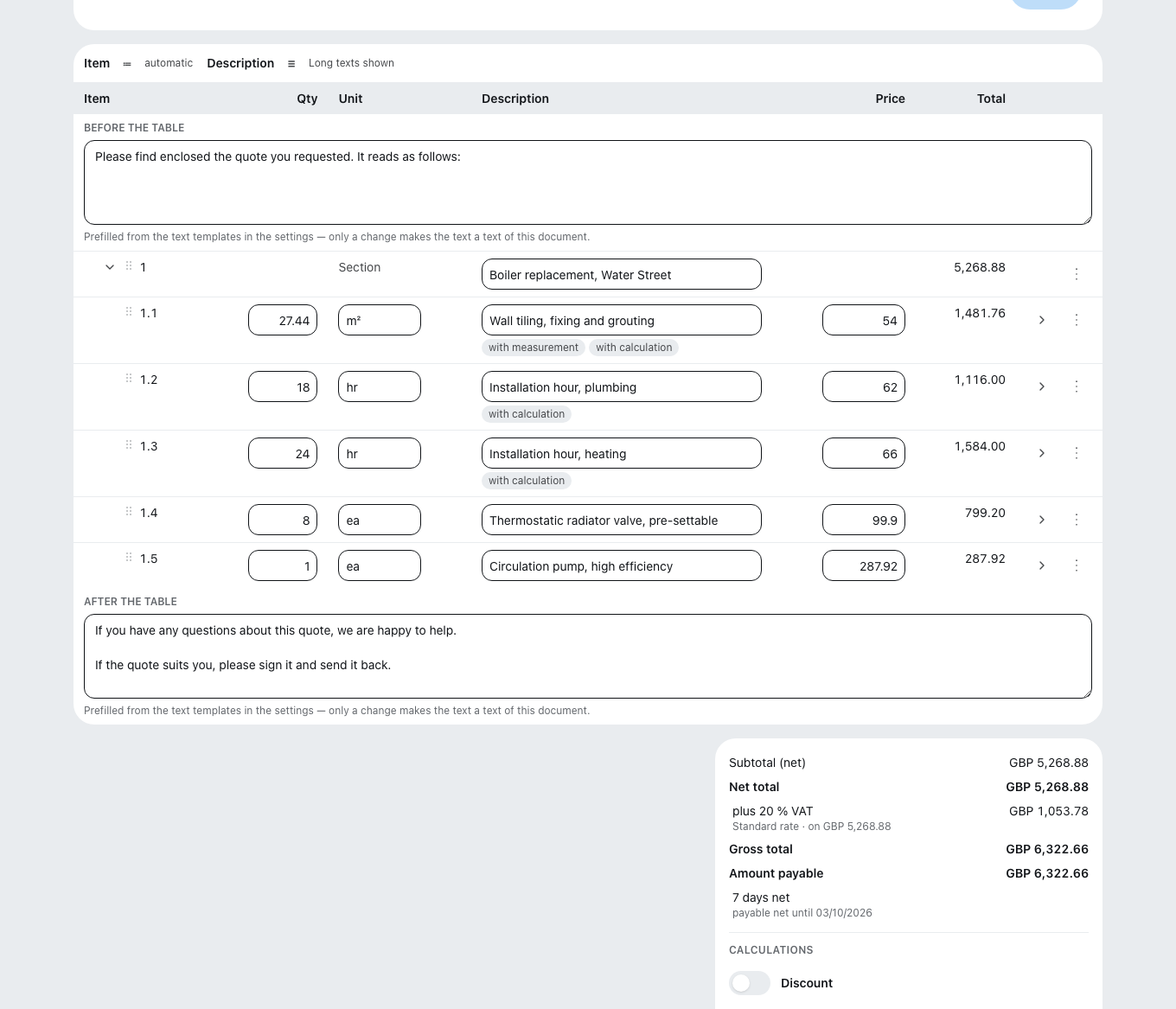
What Zirko does here: an invoice can be issued with no VAT and a fixed reverse charge note, with the notional VAT amount shown separately from the amount payable. Zirko does not decide for you whether your customer is an end user — that depends on a written notification only you have.
Frequently asked questions
When did the domestic reverse charge for construction start?
It applies to supplies with a tax point on or after 1 March 2021. HMRC had originally set 1 October 2019, then 1 October 2020; the guidance records that the introduction changed from 1 October 2020 to 1 March 2021.
Which services does the reverse charge cover?
The same list as CIS construction operations: constructing, altering, repairing, extending, demolishing or dismantling buildings or structures; works forming part of the land; installing heating, lighting, air conditioning, ventilation, power, drainage, sanitation, water and fire protection systems; internal cleaning carried out during construction; painting and decorating; and ancillary work such as site clearance, excavation, scaffolding erection, landscaping and access works.
What must the invoice say?
HMRC requires a clear note making it apparent that the domestic reverse charge applies and that the customer is required to account for the VAT, and it must show how much VAT is due under the reverse charge, or if that amount cannot be shown, state the rate of VAT. You do not add the VAT to the amount payable.
When does the reverse charge NOT apply?
It does not apply to supplies to an end user or an intermediary supplier who has notified you of that status in writing, to supplies to private individuals or other customers who are not VAT registered, to work not reported under CIS, to zero-rated supplies of building and construction services, or to supplies of workers by an employment business.
What is an end user?
HMRC defines an end user as a VAT and CIS registered business that does not make onward supplies of the building and construction services it receives. An intermediary supplier is a registered business connected or linked to an end user that buys and re-supplies construction services without making material changes to them.
What is the 5 per cent rule?
If the reverse charge element is 5 per cent or less of the value of the whole contract, that element can be disregarded and normal VAT rules apply to the lot, provided both parties agree from the outset of the contract.
Continue reading
- The four VAT positions one UK dwelling can carry
A single domestic install can carry standard-rated, reduced-rated and zero-rated work and a reverse charge at the same time — and from 1 April 2027 one of those rates changes.
- Invoice for building work: stages, variations, retention
One construction job from first application to final account: the two contract dates, why a variation gets its own line, and why retention comes off after the VAT, never before.
- Trade invoice: the weekly run, in order
The Thursday billing run for a UK trade business: what to collect first, the VAT decision that belongs to the customer rather than the invoice, the labour split, and 30 days.
- The four clocks a UK plumbing business has to run
A UK plumbing business is governed by dates it did not choose: 12 months to the next gas safety check, 28 days to get the record to the tenant, 30 days to issue the VAT invoice.
Sources
- The Value Added Tax (Section 55A) (Specified Services and Excepted Supplies) Order 2019, SI 2019/892 (checked: 29 August 2026)
- HMRC - Check when you must use the VAT domestic reverse charge for building and construction services (checked: 29 August 2026)
- HMRC - VAT domestic reverse charge technical guide (checked: 29 August 2026)
- HMRC internal manual - VAT Reverse Charge for Building and Construction Services Manual (checked: 29 August 2026)
- Finance Act 2004, section 74 - meaning of construction operations (the CIS list the reverse charge follows) (checked: 29 August 2026)