T5018: primarily construction income means reporting your subs
Income Tax Regulations section 238 requires a return from anyone whose business income is derived primarily from construction, filed six months after the reporting period ends.
Zirko RedaktionPublished: Updated: 8 min read

Contents
The T5018 is the one filing that separates construction from every other small business in Canada. A landscaper, a caterer and a software shop all pay subcontractors and none of them file this. A framing company with the same turnover does — because the obligation attaches to what you earn your money doing, not to how much of it you earn.
The legal source is section 238 of the Income Tax Regulations, and the operative sentence is short enough to read in full.
What the regulation actually requires
Section 238 obliges a return from:
"Every person or partnership that pays or credits, in a reporting period, an amount in respect of goods or services rendered on their behalf in the course of construction activities"
with the qualifier that decides who is caught:
the person's or partnership's "business income for that reporting period is derived primarily from those activities"
And the deadline:
"The return shall be filed within six months after the end of the reporting period to which it pertains."
Three consequences follow, and each of them catches somebody.
One: it is a test on your income, not on the payment. The question is not how much you paid a sub. It is whether your business income for the reporting period comes primarily from construction activities. A general contractor is caught. A property manager who also does some renovation work may not be. A manufacturer who installed its own product on site is a genuinely difficult case.
Two: it is not a size threshold. There is no revenue floor in the regulation and no employee count. A one-person operation whose income is primarily construction is inside the system on the same terms as a firm with two hundred people.
Three: six months is measured from the end of the reporting period you selected. Not from the payment, not from the calendar year end unless that is what you chose. Choosing the period and then forgetting what you chose is a common and entirely avoidable reason for filing late.
What the regulation excludes
Section 238 does not reach everything you pay out on a job. It expressly excludes amounts that are:
- entirely for goods for resale or lease — a pure material purchase is not a reportable contract payment;
- subject to section 212 of the Income Tax Act — amounts already caught by the non-resident withholding regime;
- for services rendered outside Canada by non-residents.
The first exclusion is the practical one, and it has a sharp edge: it applies to amounts entirely for goods. A supplier who delivers material and installs it is not selling you goods for resale; that is a mixed supply, and it is not obviously outside the reporting system.
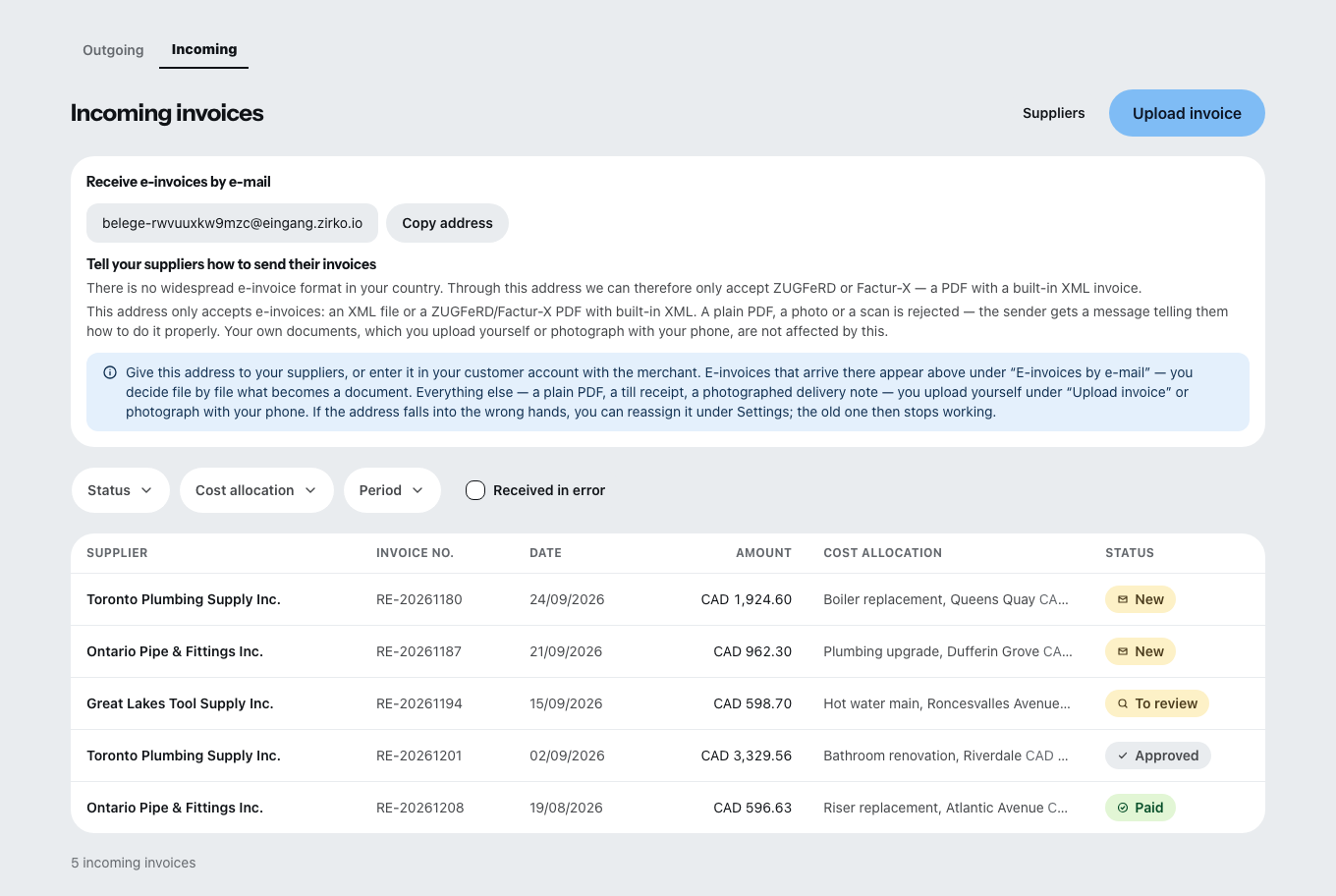
Which brings the argument back to your paperwork. If your subcontractors' invoices separate labour from material, you can answer this question. If they show one total, you cannot — and you will end up reporting either too much or too little, both of which are wrong. It is the same labour/material split a proper Canadian construction invoice needs anyway: invoicing for contractors: the $500 tier and holdback.
What this system is for
The Contract Payment Reporting System exists so that payments into the construction sector can be matched against what recipients declare. That framing is useful, because it explains two things about how the obligation behaves:
- The information is cross-checked. What you report about a sub is compared with what that sub reports. Errors surface on the other side of the transaction, not on yours.
- Accuracy of identifying information matters as much as the amount. A payment reported against a wrong or missing business number is a payment that cannot be matched, and an unmatched payment is the kind that generates correspondence.
Collect the subcontractor's legal name and business number at the start of the relationship, in the same folder as the WSIB or provincial board clearance and the certificate of insurance. Reconstructing it in month seven, from a cheque stub, is how the errors happen.
The mistake that costs more than a late filing
Reporting a payment on a T5018 says the payee was a subcontractor. It does not make them one.
Canadian law asks a different question entirely, and it asks it under two federal statutes at once. The Canada Pension Plan makes pensionable "employment in Canada that is not excepted employment" (s. 6). The Employment Insurance Act makes insurable:
"employment in Canada by one or more employers, under any express or implied contract of service or apprenticeship, written or oral, whether the earnings of the employed person are received from the employer or some other person and whether the earnings are calculated by time or by the piece, or partly by time and partly by the piece, or otherwise" (s. 5(1)(a))
A contract of service is employment; a contract for services is subcontracting. If a person you reported on a T5018 was in fact working under a contract of service, the obligation was payroll — CPP contributions, EI premiums, withholding at source and a T4 — and a T5018 does not cure it. The assessment that follows is for the employer's share plus the amounts that should have been withheld.
We cover the test that decides this in a separate article on subcontractor or employee status.
A working routine
- Decide your reporting period and write it down where the person who files can see it. Fiscal year or calendar year; then six months from its end.
- Collect legal name and business number before the first payment, alongside the clearance certificate and proof of insurance.
- Keep labour and material distinguishable on incoming invoices. The goods-for-resale exclusion cannot be applied to a single lump total.
- Total payments per payee across the whole period, not per job. Construction accounting is organized by project; this obligation is organized by payee, and the two views rarely coincide by accident.
- Classify before you report. A payee who is really an employee belongs in payroll, not in the Contract Payment Reporting System.
---
Current as of August 29, 2026. This article describes the reporting obligation in section 238 of the Income Tax Regulations and is not tax or legal advice. It does not cover the administrative guidance the Canada Revenue Agency publishes on the Contract Payment Reporting System, including any minimum reporting amount the CRA applies in practice, the form and filing channels, or penalties for late or incorrect filing — check those directly with the CRA before you file. Provincial obligations, including workers' compensation registration and clearance, are separate. The regulation quoted above was checked on the date shown.
What Zirko does: it keeps a record per business partner with company data and the documents belonging to that relationship, and it records documents with individual positions, so labour and material stay separately visible instead of collapsing into one figure. Zirko does not produce or file T5018 returns, does not transmit anything to the CRA, and does not classify workers. Issued documents are immutable; a correction is a separate document.
Frequently asked questions
Who has to file a T5018?
Income Tax Regulations section 238 requires a return from every person or partnership that pays or credits, in a reporting period, an amount in respect of goods or services rendered on their behalf in the course of construction activities — but only where the person's or partnership's business income for that reporting period is derived primarily from those activities.
What does derived primarily from construction mean?
It is a test on your own income, not on the size of the payment or the size of your business. If the majority of your business income for the reporting period comes from construction activities, the reporting obligation applies. A business that builds occasionally alongside a different main activity falls outside it.
When is the return due?
Section 238 provides that the return shall be filed within six months after the end of the reporting period to which it pertains. The reporting period is a period you select — the standard choice is your fiscal year or the calendar year — and the six months run from the end of it.
Are there payments I do not have to report?
Section 238 excludes amounts that are entirely for goods for resale or lease, amounts subject to section 212 of the Income Tax Act, and amounts for services rendered outside Canada by non-residents.
Does the T5018 replace a T4 or a T4A?
No. The T5018 reports payments to subcontractors — persons in business on their own account. If a worker is in fact your employee, the obligation is payroll withholding and a T4, and the reporting system you chose does not change that. Getting the classification wrong is a separate and more expensive problem.
Do I have to report a subcontractor who is incorporated?
The regulation is framed around amounts paid or credited for goods or services rendered in the course of construction activities, not around the legal form of the payee. Corporations, partnerships and individuals are all capable of being subcontractors on a construction job.
Continue reading
- Invoicing for contractors: the $500 tier and holdback
What a Canadian construction invoice has to carry once it passes $500, why GST/HST on holdback is not payable yet, and the 28-day clock that only starts with a proper invoice.
- Alberta prompt payment: 28 days, 7 days, and a proper invoice
The Prompt Payment and Construction Lien Act gives an owner 28 days from a proper invoice and a contractor 7 days from being paid. Invoice at least every 31 days.
- British Columbia builders lien: 45 days from the head contract
BC counts from the head contract, not your last day on site. Forty-five days to file, fifty-five days of holdback, one year to enforce — and an owner can cut that to 21 days.
- Construction lien deadlines: Ontario and Alberta 60 days, BC 45
Ontario gives 60 days to preserve and 90 more to perfect. Alberta gives 60, or 90 for concrete. British Columbia gives 45 days from the head contract and a year to enforce.
Sources
- Income Tax Regulations, C.R.C., c. 945, section 238 (Reporting of Payments in Respect of Construction Activities) (checked: August 29, 2026)
- Canada Pension Plan, R.S.C. 1985, c. C-8, section 6 (pensionable employment) (checked: August 29, 2026)
- Employment Insurance Act, S.C. 1996, c. 23, section 5 (insurable employment — contract of service) (checked: August 29, 2026)