13.5 or 23 per cent? The two-thirds rule decides Irish jobs
Construction services carry the reduced rate. But if the materials cost more than two thirds of the price you charge, Revenue applies the rate of the goods to the whole job.
Zirko RedaktionPublished: Updated: 9 min read
Contents
A plumber quotes 4,200 euro to supply and fit a heating system. Materials cost 3,000 euro. The quote says 13.5 per cent VAT. It is wrong, and the difference is 399 euro out of the plumber's margin.
The rule that did that is the two-thirds rule, and it is the single most expensive piece of Irish VAT law for small trade businesses, because it turns on a ratio nobody checks until after the job is priced.
The rates, as they stand
Revenue's current VAT rates, effective from 1 January 2026:
| Rate | Percentage |
|---|---|
| Standard rate | 23 % |
| Reduced rate | 13.5 % |
| Second reduced rate | 9 % |
| Livestock rate | 4.8 % |
| Flat-rate compensation for farmers | 4.5 % |
For construction, the everyday pair is 13.5 and 23. Which one applies depends on what you are supplying, and then on the ratio of goods to price.
What is at 13.5 per cent
Revenue's Tax and Duty Manual on the VAT treatment of construction services lists the reduced-rate items:
- "The supply of construction services which includes construction work generally; renovation and demolition of buildings; maintenance and repair of buildings; the installation of plumbing, heating and electrical services; and the supply and installation, maintenance and repair of fixtures."
- "The supply and placing in a fixed position of garden sheds, greenhouses and similar structures", subject to conditions.
- "The supply only of ready to pour concrete and concrete blocks", subject to conditions — the statutory basis being paragraph 16 of Schedule 3 to the VAT Consolidation Act 2010.
- "The installation of solar panels (subject to the two-thirds rule) if there is a separate installation contract."
What is at 23 per cent
The same manual lists the standard-rated items, and each of them is a trap in a mixed job:
- "The supply of all other building materials."
- "The supply of scaffolding, the hire of scaffolding, and the hire and erection of scaffolding."
- "The supply of fittings, the installation of fittings, and the supply and installation of fittings."
Fixtures at 13.5, fittings at 23. That single distinction accounts for a large share of Irish construction VAT errors. A fixture is attached to the building in a way that makes it part of it; a fitting is not. Getting it wrong on a kitchen or a bathroom is the difference between two rates on the same invoice.
What is at 9 per cent
Two construction-relevant items sit at the second reduced rate, per the same manual:
- "With effect from 26 November 2025 to 31 Dec 2030, services relating to the construction, until completed, of qualifying apartments."
- "The supply and installation of heat pump heating systems."
Both are narrow, both are defined by further Revenue guidance, and neither should be assumed from the description alone. The apartment measure in particular is time limited and conditional.
The two-thirds rule, in Revenue's words
If the cost of the goods used in carrying out the work exceeds two-thirds of the total price, the rate which applies to the goods then applies to the entire transaction.
And the converse:
If the cost of the goods does not exceed two thirds, the rate which applies to the service then applies to the entire transaction.
Note precisely what is being compared. The cost of the goods to you, VAT exclusive, against the total price you charge, VAT exclusive. Not your selling price for the materials. Not the labour proportion. Cost in, price out.
The worked example
Back to the heating job. Both figures VAT exclusive:
| Case A | Case B | |
|---|---|---|
| Cost of goods to you | €3,000 | €2,600 |
| Total price charged | €4,200 | €4,200 |
| Two thirds of the price | €2,800 | €2,800 |
| Goods exceed two thirds? | yes | no |
| Rate on the whole job | 23 % | 13.5 % |
| VAT | €966 | €567 |
Four hundred euro of materials moves the entire job across the line, and the VAT difference is 399 euro. If the customer was quoted a VAT-inclusive price, that comes straight out of the margin.
Three practical consequences:
- Test the ratio at quoting time, not at invoicing time. It is arithmetic you can do before the price is fixed.
- A supplier price rise can flip a job that was priced correctly. If materials go up 10 per cent after you quoted, re-run the test.
- Where you are close to the line, say the price is exclusive of VAT and state the rate that will apply. A VAT-inclusive quote on a marginal job is a bet on your own supplier.
Where the rule is switched off
Revenue lists three cases where the two-thirds rule does not apply:
- repair and maintenance of motor vehicles and agricultural machinery;
- construction services where principal contractors account for VAT on the receipt of construction services from sub-contractors; and
- construction services between connected parties.
The middle one is the important one for subcontractors. On a reverse charge supply there is no rate on your invoice at all, so there is nothing for the ratio to change. The principal accounts for the VAT and applies the correct rate at their end.
The consequence is easy to state and easy to forget: the same firm can be inside the two-thirds rule on Monday and outside it on Tuesday, depending on who the customer is.
Two separate questions, in order
Most rate errors come from collapsing two questions into one. Keep them apart:
Question 1: what is the correct rate for this supply? Fixture or fitting, service or goods, ordinary construction or a qualifying apartment. This is a classification question.
Question 2: does the two-thirds rule move it? This is an arithmetic question, and it only arises once question 1 has an answer.
Answering question 2 first — "it is mostly materials so it must be 23" — produces the wrong result on jobs where the supply was standard rated anyway, and on jobs where the rule is switched off.
A short checklist
- Record the VAT-exclusive cost of materials per job. Without it the ratio cannot be tested at all.
- Test at quote, and again if supplier prices move.
- Classify fixtures and fittings deliberately on kitchens, bathrooms and shopfitting. It is the most common misclassification in Irish construction VAT.
- Skip the ratio test on reverse charge jobs and connected-party jobs. The rule does not apply.
- Check the narrow 9 per cent categories against Revenue's own guidance before pricing a qualifying apartment or a heat pump. Both are conditional.
---
Position as at 29 August 2026. This article describes the law and is not tax advice. Irish VAT rates and the categories within them change in Finance Acts; Revenue's rates page and its Tax and Duty Manual on construction services are the sources checked for this article on the date shown.
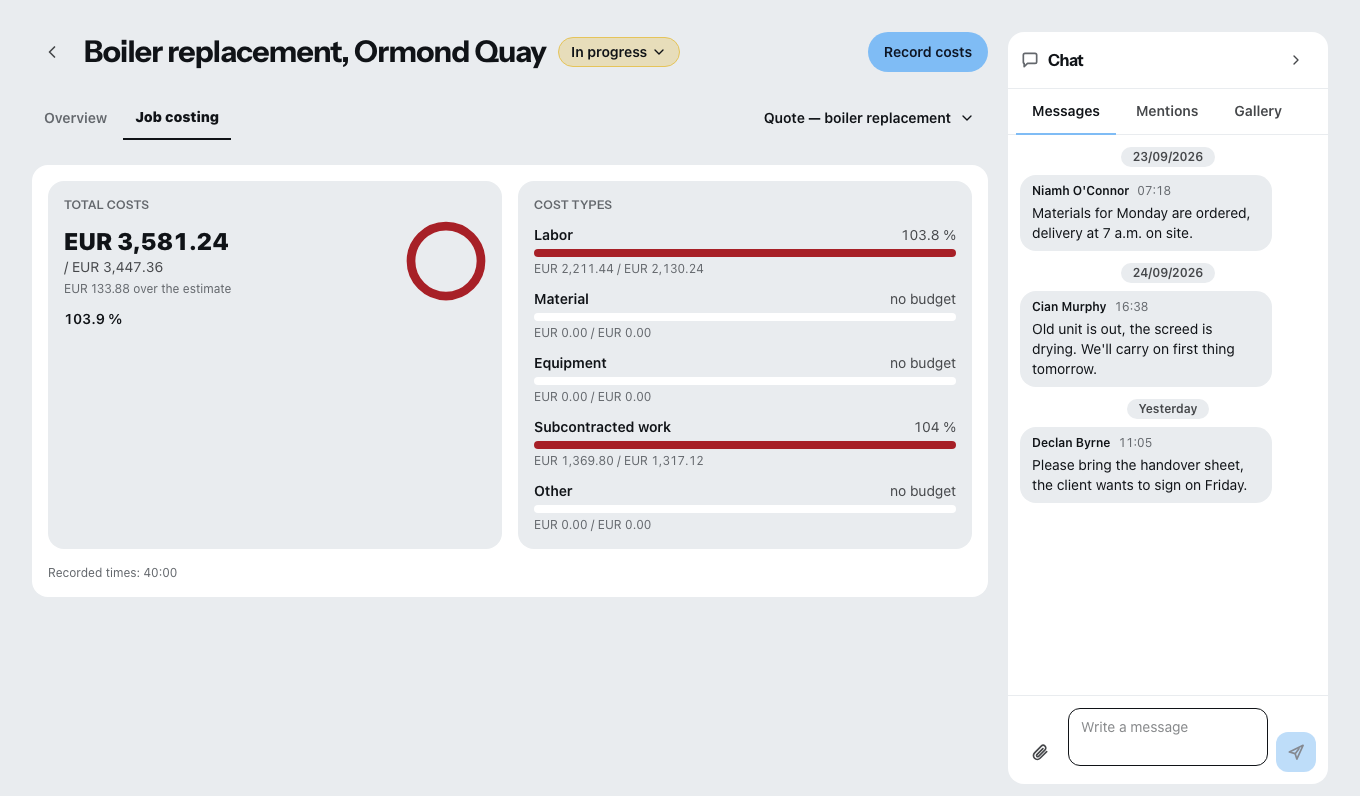
What Zirko does here: a document holds the rate that applied on the day it was issued, so a rate change next year cannot rewrite last year's invoice. Zirko does not run the two-thirds test for you — it does not know your material costs unless they are on the job.
Frequently asked questions
What are the current Irish VAT rates?
As shown by Revenue for rates effective from 1 January 2026: standard rate 23 per cent, reduced rate 13.5 per cent, second reduced rate 9 per cent, livestock rate 4.8 per cent, and flat-rate compensation for farmers 4.5 per cent.
What rate applies to construction services?
The reduced rate. Revenue lists it as applying to the supply of construction services, which includes construction work generally, renovation and demolition of buildings, maintenance and repair of buildings, the installation of plumbing, heating and electrical services, and the supply and installation, maintenance and repair of fixtures.
What is the two-thirds rule?
Revenue states it plainly: if the cost of the goods used in carrying out the work exceeds two-thirds of the total price, the rate which applies to the goods then applies to the entire transaction. If it does not exceed two thirds, the rate which applies to the service applies to the entire transaction.
When does the two-thirds rule not apply?
Revenue lists three cases: repair and maintenance of motor vehicles and agricultural machinery, construction services where principal contractors account for VAT on the receipt of construction services from sub-contractors, and construction services between connected parties.
What is standard rated in a building job?
Revenue lists the supply of all other building materials, the supply of scaffolding, the hire of scaffolding and the hire and erection of scaffolding, and the supply of fittings, the installation of fittings, and the supply and installation of fittings.
Which construction work is at the second reduced rate?
Revenue's manual on the VAT treatment of construction services lists two: with effect from 26 November 2025 to 31 December 2030, services relating to the construction, until completed, of qualifying apartments; and the supply and installation of heat pump heating systems.
Continue reading
- The VAT limit in Ireland is €42,500, not €85,000
Two thresholds, and the bigger one carries a 90 per cent condition almost no trade business meets. Revenue sends builders to the services figure.
- Pro forma invoice: harmless until somebody pays it
A pro forma carries no sequential number, no VAT liability and no right to deduct. The day the money arrives, an Irish supply is deemed to take place.
- RCT invoice: €10,000 billed, €8,000 paid, no VAT
A sample invoice for an Irish subcontractor — no VAT rate, no VAT amount, one prescribed sentence, and a net figure the invoice cannot know because Revenue has not issued it yet.
- The payment claim notice: five days that decide if you get paid
The Construction Contracts Act 2013 gives you a payment claim notice, a response deadline of 21 days, a right to suspend on seven days notice and adjudication in 28.
Sources
- Revenue - Current VAT rates (checked: 29 August 2026)
- Revenue Tax and Duty Manual - VAT treatment of construction services (rates, two-thirds rule, reverse charge) (checked: 29 August 2026)
- Revenue - Services taxable at the rate of the goods (the two-thirds rule) (checked: 29 August 2026)
- Value-Added Tax Consolidation Act 2010, Schedule 3 - goods and services chargeable at the reduced rate (checked: 29 August 2026)