Safe Pass: the card the law puts on the contractor
Regulation 25 of the Construction Regulations 2013 does not say a worker must hold a Safe Pass card. It says every contractor must ensure each person under his control holds one.
Zirko RedaktionPublished: Updated: 8 min read
Contents
Read regulation 25 of the Construction Regulations 2013 carefully and you will notice it is not addressed to the worker at all.
Every contractor or other person under whose direct control persons work on a construction site shall ensure that each of those persons … is in possession of a valid safety awareness registration card referred to in Schedule 4 if Regulation 4(2) applies to the worker.
The duty sits on the contractor. A worker without a card is a problem, but it is your problem, and it is the person paying for the labour who is in breach.
That is worth knowing before the next time someone turns up on a Monday morning saying the card is at home.
What the card actually is
Schedule 4 to S.I. No. 291 of 2013 sets out the Safety Awareness Scheme. Paragraph 1 states that the requirement for the issue of a valid safety awareness registration card is successful completion of any one of:
- "the FÁS Safe Pass training programme";
- "an equivalent safety awareness scheme approved by FÁS"; or
- "an equivalent safety awareness scheme in another Member State of the European Union approved by FÁS".
Paragraph 2 defines a valid card as the Safe Pass registration card, a card with photographic identification issued by a body prescribed by the Minister, or a card issued in association with an approved scheme in another Member State.
The Regulations still name FÁS. The functions passed to SOLAS, and it is SOLAS that runs the programme and the National Construction Scheme Database today. The statutory reference has not been renamed; the body behind it has.
Two practical points follow from paragraph 1(c). An equivalent card from another EU Member State can be valid — but only where it comes from an approved scheme. It is not a matter of the card looking similar.
Who needs one
Regulation 4(2) applies Schedule 4 to:
(a) craft and general construction workers, (b) persons undertaking on-site security work, and (c) persons or classes of persons as may be prescribed by the Minister.
Broad, and deliberately so. If someone is doing craft or general construction work on your site, they are in.
Regulation 4(3) provides the only meaningful exemption, and it is narrow enough that most people who invoke it do not qualify. It disapplies Schedule 4 to a person "involved in the installation, commissioning, maintenance, repair or removal of mechanical, electrical, gas, compressed air, hydraulic, telecommunication and computer systems, or similar services", where all three of the following are true:
- the person is normally domiciled outside the State;
- their normal place of employment is outside the State; and
- they have not been working on the project for more than 20 working days in any 12 month period.
The specialist commissioning engineer flown in for a fortnight is the case this was written for. Regulation 4(4) then requires that person to carry a letter, in English or Irish, from the employer, which describes the work to be undertaken, states the competence of the person to undertake it, and gives the commencement date and the anticipated completion date.
And under regulation 25(1)(c), a worker covered by that exemption must instead have received site-specific safety induction instruction. The exemption removes the card, not the briefing.
Four years, and the renewal exam
SOLAS states plainly that "Safe Pass Registration Cards are issued for four years after which time the card holder must attend a Safe Pass course to update their safety awareness training". The initial programme is "a mandatory one-day health and safety awareness programme".
There is now an alternative to sitting the day again. SOLAS operates a computer-based renewal exam: "The exam consists of 50 multiple choice questions" and "you must answer 45 questions correctly to pass", within a total of 45 minutes.
45 out of 50 is a 90 per cent pass mark. It is not a formality, and sending someone to it cold on the strength of four years on site is how a card lapses.
Cards are not issued on the day of the course either: SOLAS notes that the card is issued to the tutor about five working days after results are uploaded to the National Construction Scheme Database.
The first-day duty most contractors skip
Regulation 25(2) is short and it is the part that turns up in an inspection:
On the date upon which a worker first commences work on a construction site, the contractor or other person under whose direct control the worker is working shall— (a) ask to see the appropriate valid registration card referred to in paragraph (1), and (b) furnish to the project supervisor for the construction stage written confirmation that the worker is in possession of (i) the valid registration card, and (ii) other relevant certificates and documentation required under the relevant statutory provisions.
Two acts, one of them written. Not "keep a copy in the office"; furnish written confirmation to the PSCS on the day.
The mirror duty sits on the PSCS in regulation 19(a) and (b): coordinate arrangements to ensure that persons at work on the site to whom regulation 4(2) applies each hold a valid safety awareness registration card, and that those engaging in Schedule 5 tasks each hold the appropriate construction skills registration card.
And on the worker, regulation 29(1)(g): show the relevant registration cards referred to in regulations 19 and 25 when requested by the employer or the PSCS.
Forgery is a separate offence
Regulation 29(2) makes it an offence for a person to:
- make a statement known to be false when applying for a registration card or certificate under Schedules 4 or 5;
- with intent to deceive, forge or alter such a card or certificate; or
- with intent to deceive, make, supply or possess any document closely resembling a card or certificate required under the Regulations.
The third limb is the one to point at when someone produces a laminated card that is "basically the same". Possessing a close imitation with intent to deceive is itself prohibited.
A short checklist
- Check cards on day one and record the check. The regulation requires you to ask, and to confirm in writing to the PSCS.
- Track expiry dates, not just possession. Four years passes quietly, and a lapsed card is the same as no card.
- Book renewals early. A 90 per cent pass mark is not something to attempt at the last minute.
- Do not rely on regulation 4(3) unless all three conditions hold. Domiciled abroad, employed abroad, and under 20 working days on the project in twelve months.
- Give the exempt visitor a site-specific induction and keep the employer's letter. Both are required, and both are documents an inspector can ask for.
---
Position as at 29 August 2026. This article describes the law and is not legal or safety advice. S.I. No. 291 of 2013 has been amended since it was made, and the functions it assigns to FÁS are now exercised by SOLAS.
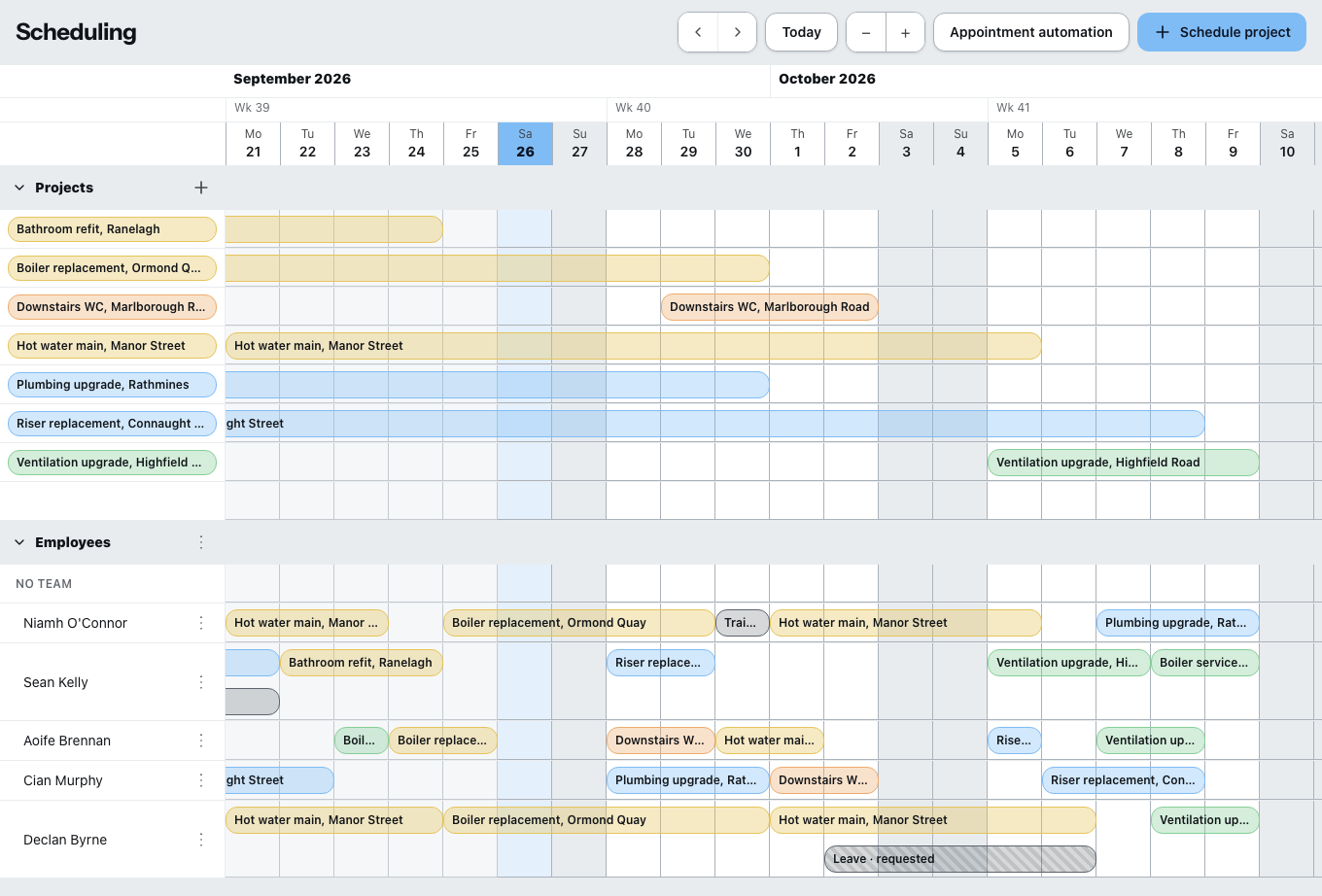
What Zirko does here: staff and their site assignments sit in one plan, so the question of who is on which site next week has an answer before anyone rings. Zirko is not a card register: it does not hold Safe Pass numbers, does not track expiry dates and does not check anything against the National Construction Scheme Database. That check belongs to SOLAS, and the sighting on day one belongs to you.
Frequently asked questions
What law makes Safe Pass compulsory?
Regulation 25(1)(a) of the Safety, Health and Welfare at Work (Construction) Regulations 2013, S.I. No. 291 of 2013. Every contractor or other person under whose direct control persons work on a construction site shall ensure that each of those persons is in possession of a valid safety awareness registration card referred to in Schedule 4 if Regulation 4(2) applies to the worker.
Who does the Safe Pass requirement cover?
Regulation 4(2) applies Schedule 4 to craft and general construction workers, persons undertaking on-site security work, and persons or classes of persons as may be prescribed by the Minister.
How long is a Safe Pass card valid?
Four years. SOLAS states that Safe Pass Registration Cards are issued for four years after which time the card holder must attend a Safe Pass course to update their safety awareness training.
What must a contractor do on a worker's first day?
Regulation 25(2) requires the contractor, on the date the worker first commences work on a construction site, to ask to see the appropriate valid registration card and to furnish to the project supervisor for the construction stage written confirmation that the worker holds the valid card and the other relevant certificates and documentation required.
Is there any exemption from Safe Pass?
A narrow one. Regulation 4(3) disapplies Schedule 4 to a person involved in installing, commissioning, maintaining, repairing or removing mechanical, electrical, gas, compressed air, hydraulic, telecommunication and computer systems where the person is normally domiciled outside the State, their normal place of employment is outside the State, and they have not worked on the project for more than 20 working days in any 12 month period. Regulation 4(4) requires that person to carry a letter in English or Irish from the employer describing the work, stating their competence and giving the start and expected finish dates.
Can the card be renewed without doing the day course again?
SOLAS operates an alternative renewal test. The exam consists of 50 multiple choice questions and you must answer 45 questions correctly to pass; the test takes a total of 45 minutes.
Continue reading
- Pro forma invoice: harmless until somebody pays it
A pro forma carries no sequential number, no VAT liability and no right to deduct. The day the money arrives, an Irish supply is deemed to take place.
- RCT invoice: €10,000 billed, €8,000 paid, no VAT
A sample invoice for an Irish subcontractor — no VAT rate, no VAT amount, one prescribed sentence, and a net figure the invoice cannot know because Revenue has not issued it yet.
- The payment claim notice: five days that decide if you get paid
The Construction Contracts Act 2013 gives you a payment claim notice, a response deadline of 21 days, a right to suspend on seven days notice and adjudication in 28.
- CSCS cards: the twenty-one tasks you may not do without one
Safe Pass gets you onto the site. A construction skills registration card is what lets you operate the machine, and Schedule 5 to the Construction Regulations 2013 names every task.
Sources
- Safety, Health and Welfare at Work (Construction) Regulations 2013, S.I. No. 291 of 2013 (regulations 4, 19, 25, 29 and Schedule 4) (checked: 29 August 2026)
- SOLAS - Safe Pass: programme, card validity and the renewal exam (checked: 29 August 2026)
- SOLAS - Construction course information (checked: 29 August 2026)